Pipeline Identity and Secrets (ID)
Taxonomies › Software factory › Pipeline Identity and Secrets
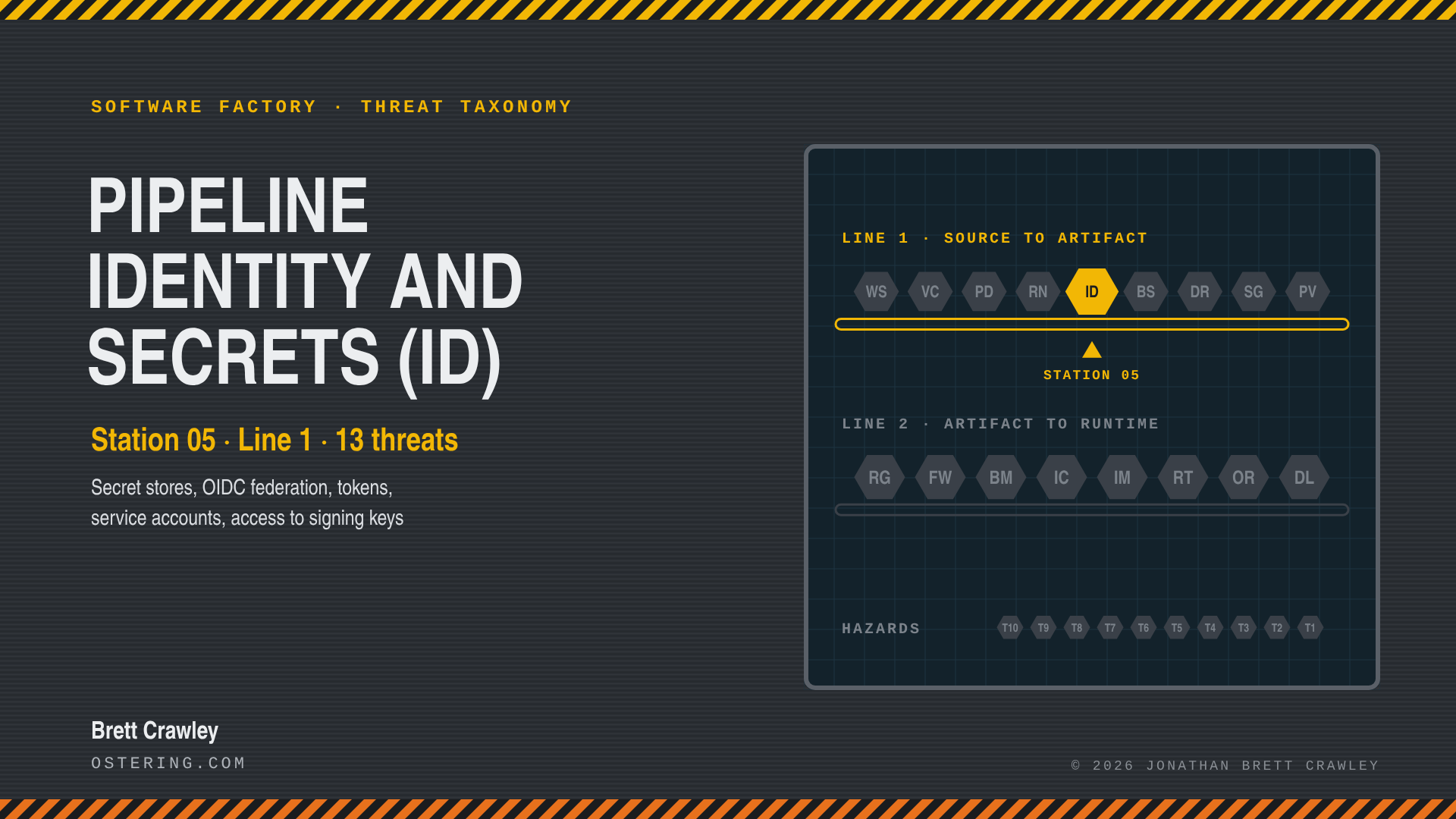
Station 05 of 17 · Line 1, Source to Artifact · 13 threats · prefix ID
The pipeline is usually the most privileged identity in the organisation, and most attacks on it end in credential theft. These cards cover secret stores, federated identity, job tokens, service accounts and access to signing keys.
Scope: Secret stores, OIDC federation, tokens, service accounts, access to signing keys.
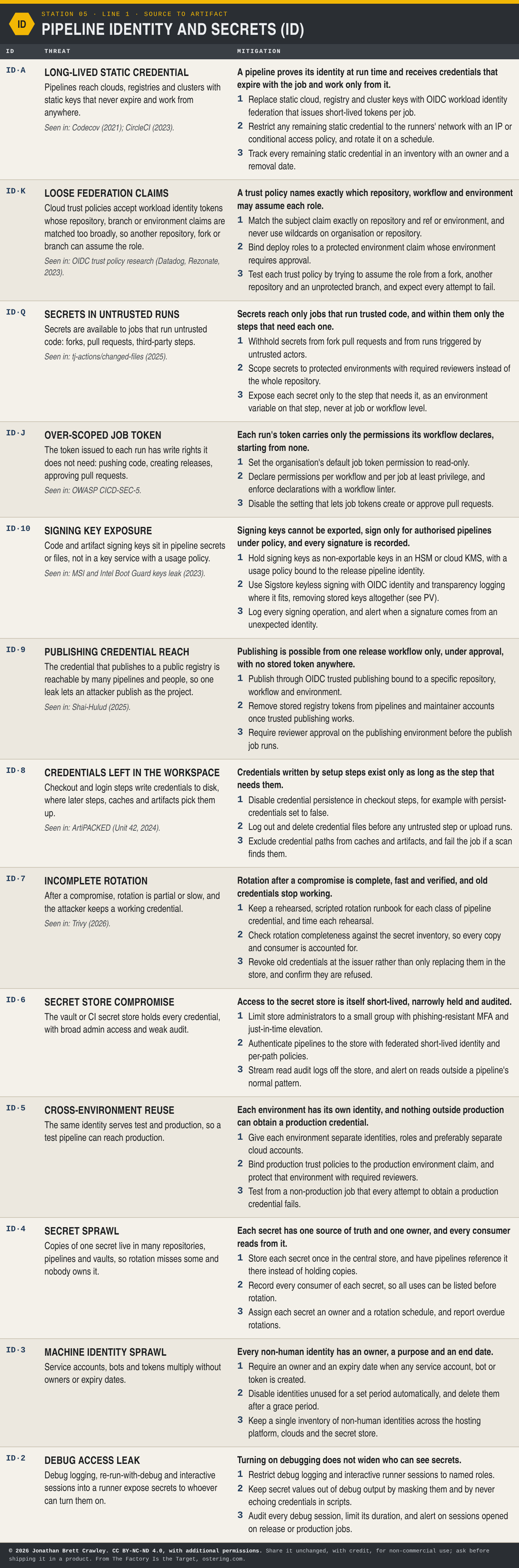
Text version: every entry on this page is in the PDF and Excel downloads on the overview page, where it can be searched and copied.
The threats
- ID·A Long-Lived Static Credential
- ID·K Loose Federation Claims
- ID·Q Secrets in Untrusted Runs
- ID·J Over-Scoped Job Token
- ID·10 Signing Key Exposure
- ID·9 Publishing Credential Reach
- ID·8 Credentials Left in the Workspace
- ID·7 Incomplete Rotation
- ID·6 Secret Store Compromise
- ID·5 Cross-Environment Reuse
- ID·4 Secret Sprawl
- ID·3 Machine Identity Sprawl
- ID·2 Debug Access Leak
Where this station touches others
- Pipeline Identity and Secrets and every other station: Pipeline Identity covers the credentials themselves; each other station covers what a credential lets its component do.
Seen in the wild
- ID·A Long-Lived Static Credential: Codecov (2021); CircleCI (2023).
- ID·K Loose Federation Claims: OIDC trust policy research (Datadog, Rezonate, 2023).
- ID·Q Secrets in Untrusted Runs: tj-actions/changed-files (2025).
- ID·J Over-Scoped Job Token: OWASP CICD-SEC-5.
- ID·10 Signing Key Exposure: MSI and Intel Boot Guard keys leak (2023).
- ID·9 Publishing Credential Reach: Shai-Hulud (2025).
- ID·8 Credentials Left in the Workspace: ArtiPACKED (Unit 42, 2024).
- ID·7 Incomplete Rotation: Trivy (2026).
Sources for each case are listed on the overview page.
STRIDE, CAPEC and CWE
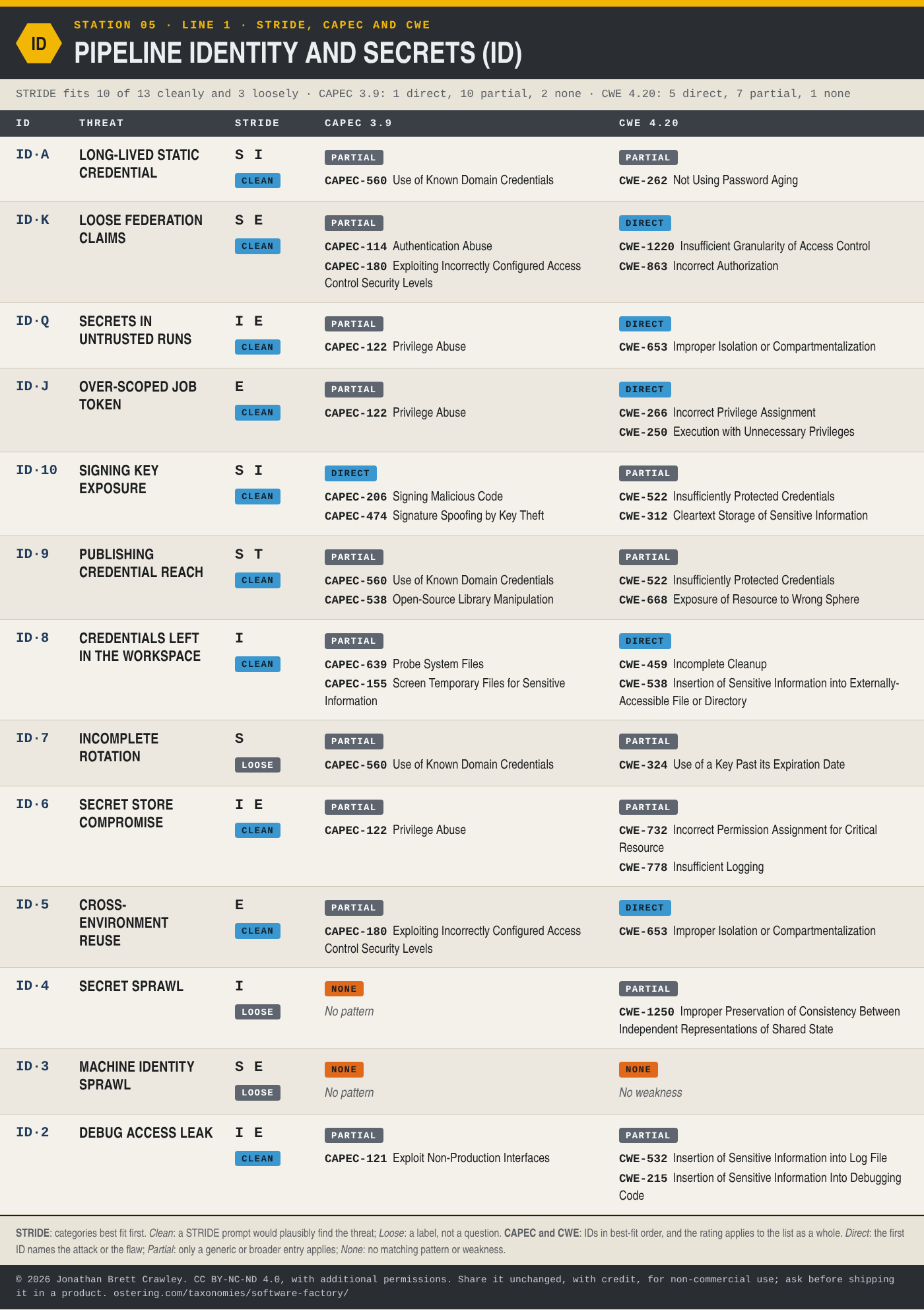
Of the 13 entries here, STRIDE fits 10 cleanly and 3 only loosely. CAPEC 3.9 has a pattern that describes 1 of them directly, only a generic parent pattern for 10, and nothing for 2. CWE 4.20 names the weakness directly for 5, has only a broader weakness for 7, and nothing for 1. The table below gives the mapping entry by entry, with the names of the CAPEC patterns and CWE weaknesses; what the mapping shows across the whole taxonomy is in Mapping the Software Factory Threat Taxonomy to STRIDE, CAPEC and CWE. The Excel, SKOS and STIX downloads carry the same mapping as text.
← Runners (RN) · Software factory overview · Build Systems (BS) →
© 2026 Jonathan Brett Crawley. Licensed under CC BY-NC-ND 4.0 with additional permissions: see the licence on the software factory overview.