Content scanners (CS)
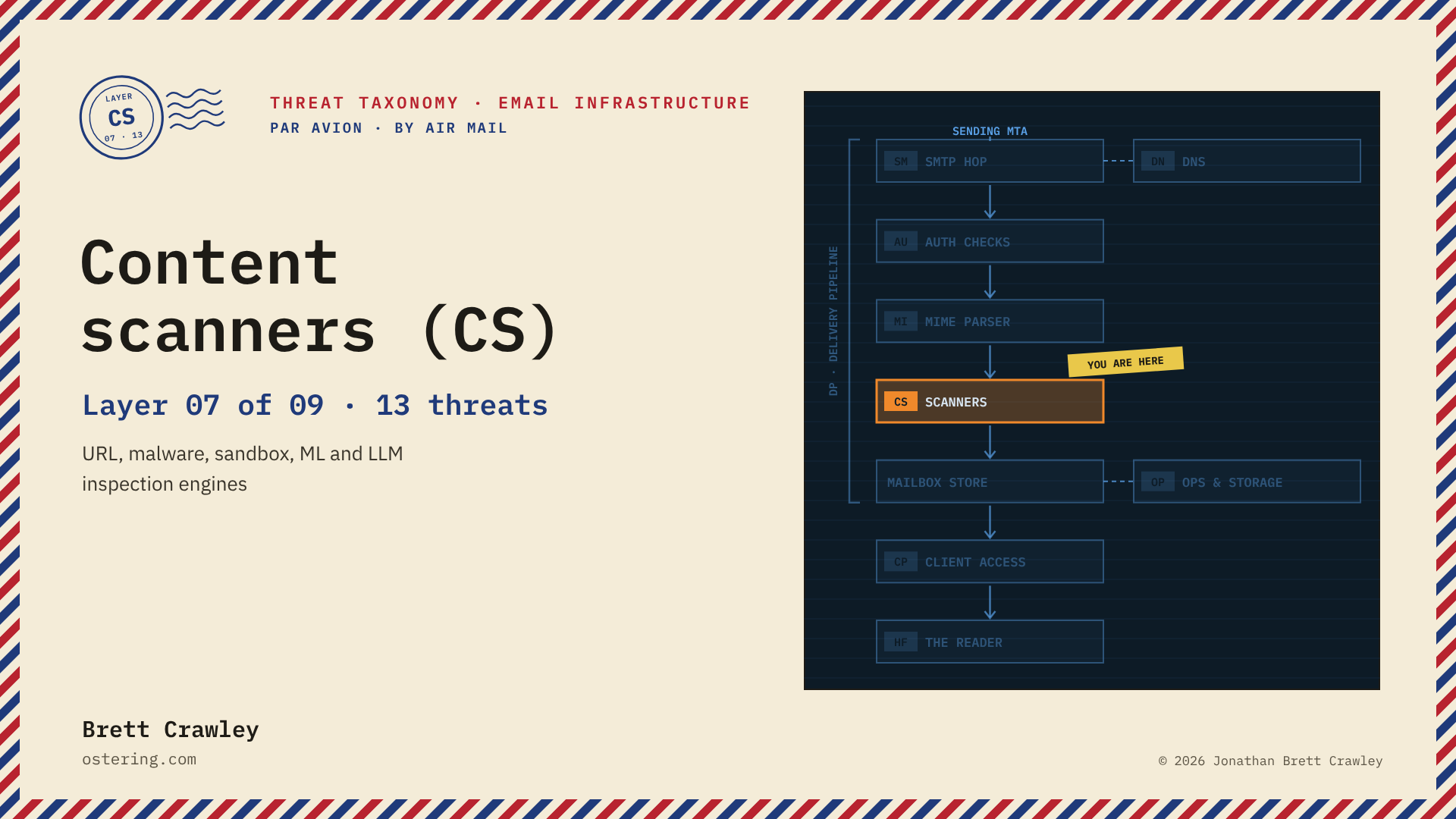
Taxonomies › Email infrastructure › Content scanners
Layer 07 of 09 · 13 threats · prefix CS
A scanner is a probabilistic control that an attacker can study, evade and attack directly. These entries cover URL analysis, malware detection, sandboxes, machine learning (ML) and large language model (LLM) classifiers, and data loss prevention (DLP).
Scope: URL, malware, sandbox, ML and LLM inspection engines.
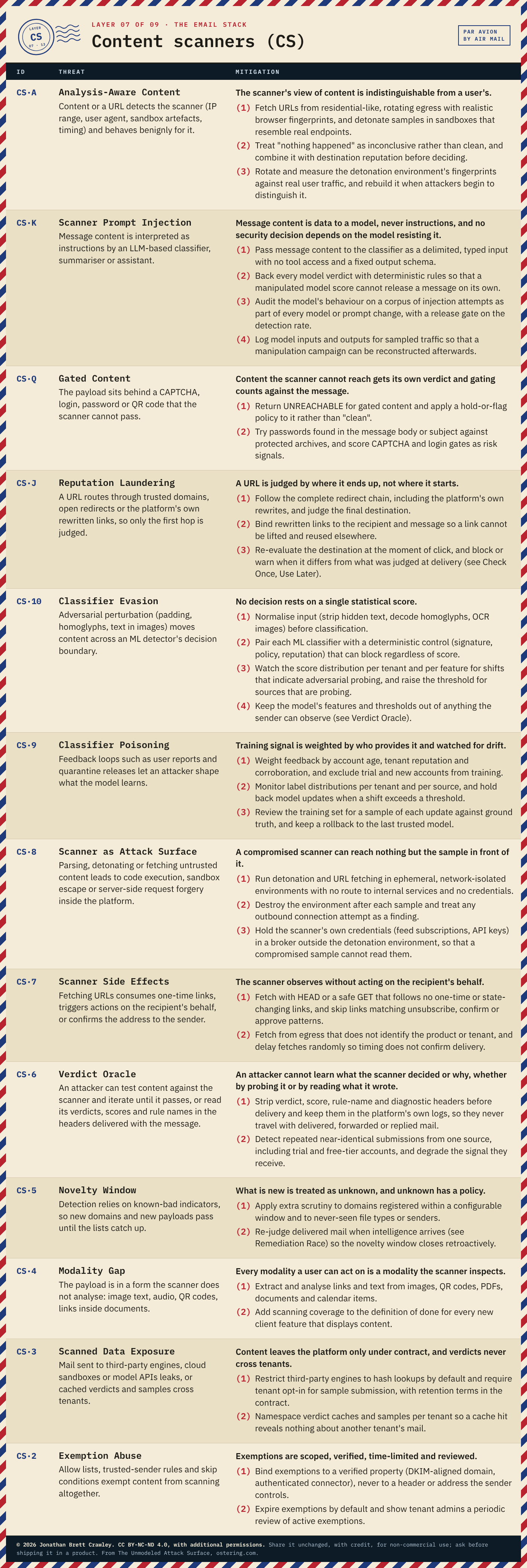
Text version: every entry on this page is in the PDF and Excel downloads on the overview page, where it can be searched and copied.
The threats
- CS·A Analysis-Aware Content
- CS·K Scanner Prompt Injection
- CS·Q Gated Content
- CS·J Reputation Laundering
- CS·10 Classifier Evasion
- CS·9 Classifier Poisoning
- CS·8 Scanner as Attack Surface
- CS·7 Scanner Side Effects
- CS·6 Verdict Oracle
- CS·5 Novelty Window
- CS·4 Modality Gap
- CS·3 Scanned Data Exposure
- CS·2 Exemption Abuse
Where this layer touches others
- Delivery pipeline and content scanners: the pipeline decides what to do with a scanner’s limits and verdicts. The scanner layer asks whether the inspection itself holds up.
STRIDE, CAPEC and CWE
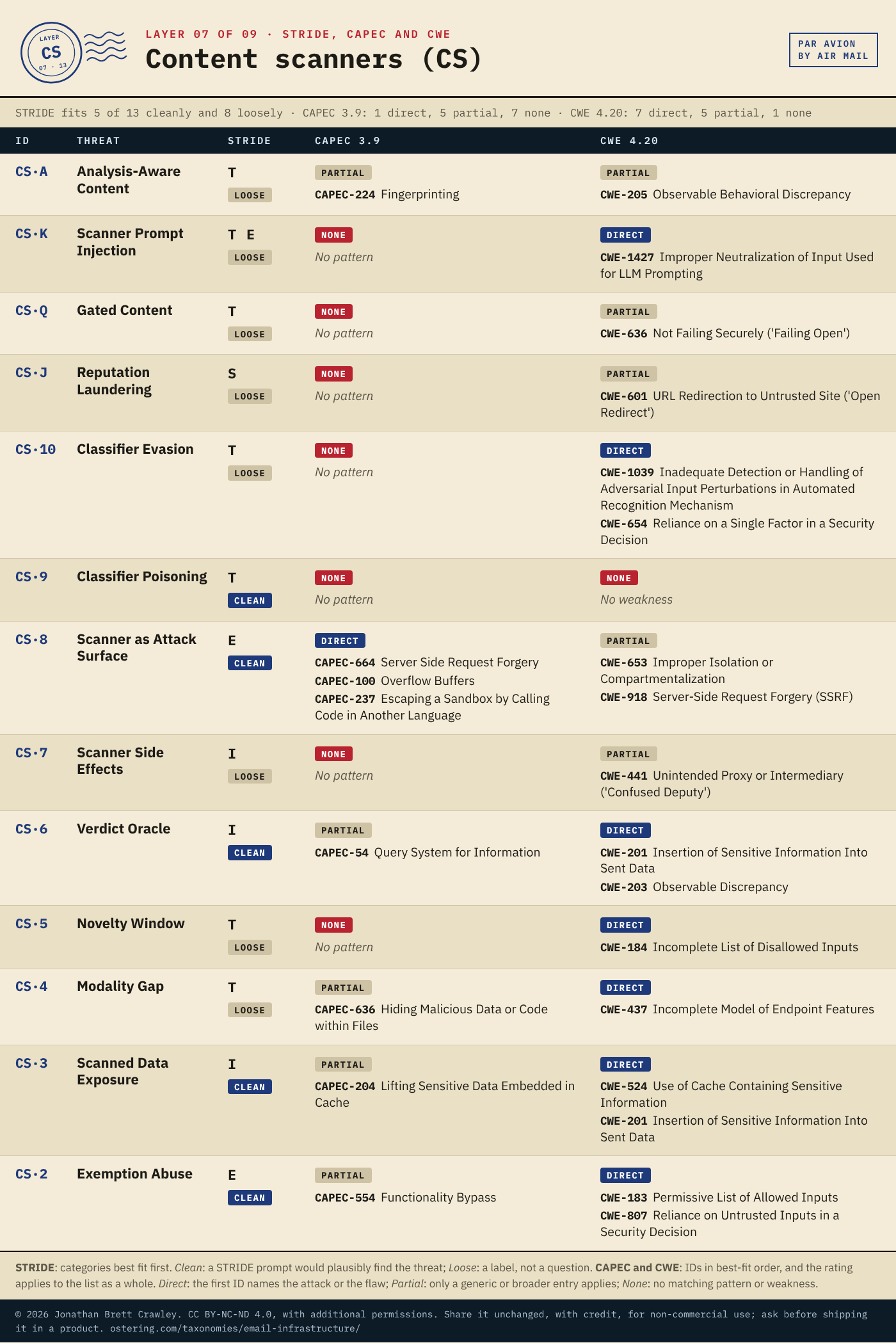
Of the 13 entries here, STRIDE fits 5 cleanly and 8 only loosely. CAPEC 3.9 has a pattern that describes 1 of them directly, only a generic parent pattern for 5, and nothing for 7. CWE 4.20 names the weakness directly for 7, has only a broader weakness for 5, and nothing for 1. The table below gives the mapping entry by entry, with the names of the CAPEC patterns and CWE weaknesses; what the mapping shows across the whole taxonomy is in Mapping the Email Threat Taxonomy to STRIDE, CAPEC and CWE. The Excel, SKOS and STIX downloads carry the same mapping as text.
← DNS layer (DN) · Email infrastructure overview · Human-facing layer (HF) →
© 2026 Jonathan Brett Crawley. Licensed under CC BY-NC-ND 4.0 with additional permissions: see the licence on the email infrastructure overview.