Structural hazards (T)
Taxonomies › Email infrastructure › Structural hazards
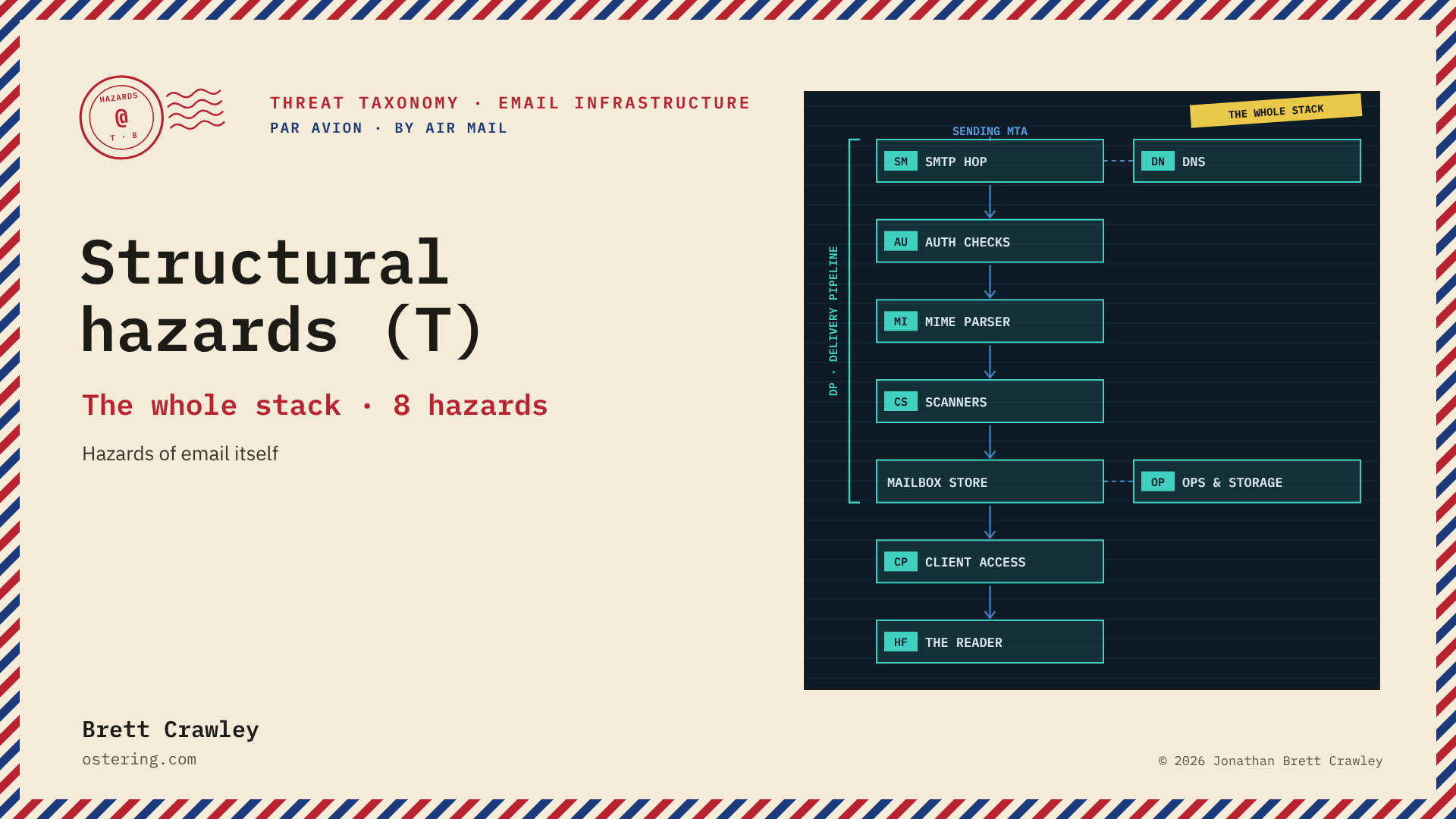
The whole stack · 8 hazards · prefix T
These eight hazards are properties of email itself, so no single component can fix them. Apply them to the whole design after the layers.
Scope: Hazards of email itself.
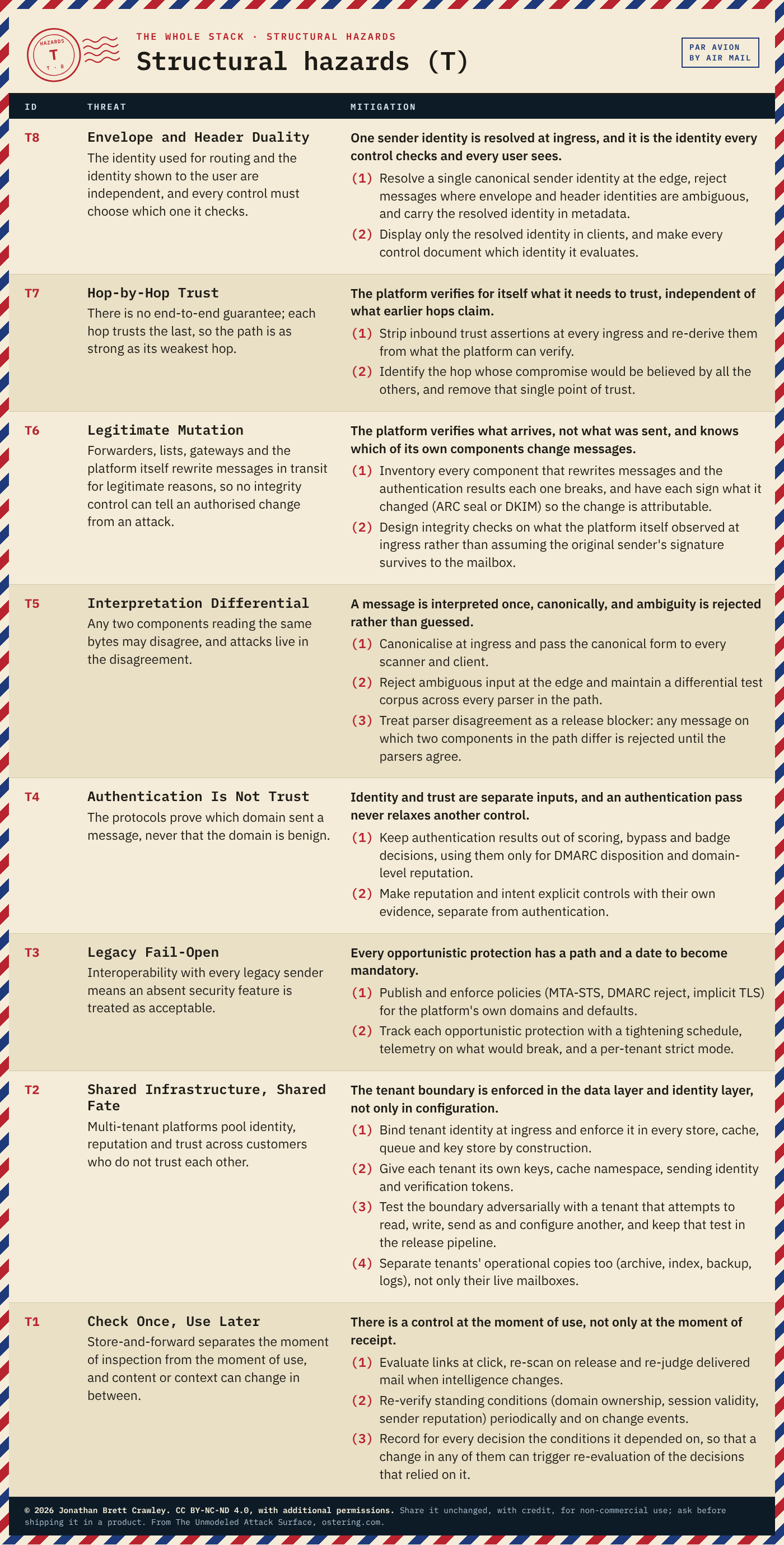
Text version: every entry on this page is in the PDF and Excel downloads on the overview page, where it can be searched and copied.
The hazards
- T8 Envelope and Header Duality
- T7 Hop-by-Hop Trust
- T6 Legitimate Mutation
- T5 Interpretation Differential
- T4 Authentication Is Not Trust
- T3 Legacy Fail-Open
- T2 Shared Infrastructure, Shared Fate
- T1 Check Once, Use Later
Where this group touches others
- Tenancy: Tenant Confusion (DP·7), Cross-Tenant Identity (AU·K) and Shared Reputation Poisoning (SM·8) each cover a different face of shared infrastructure (configuration, identity, reputation). Shared Infrastructure, Shared Fate (T2) is the structural hazard behind all three.
STRIDE, CAPEC and CWE
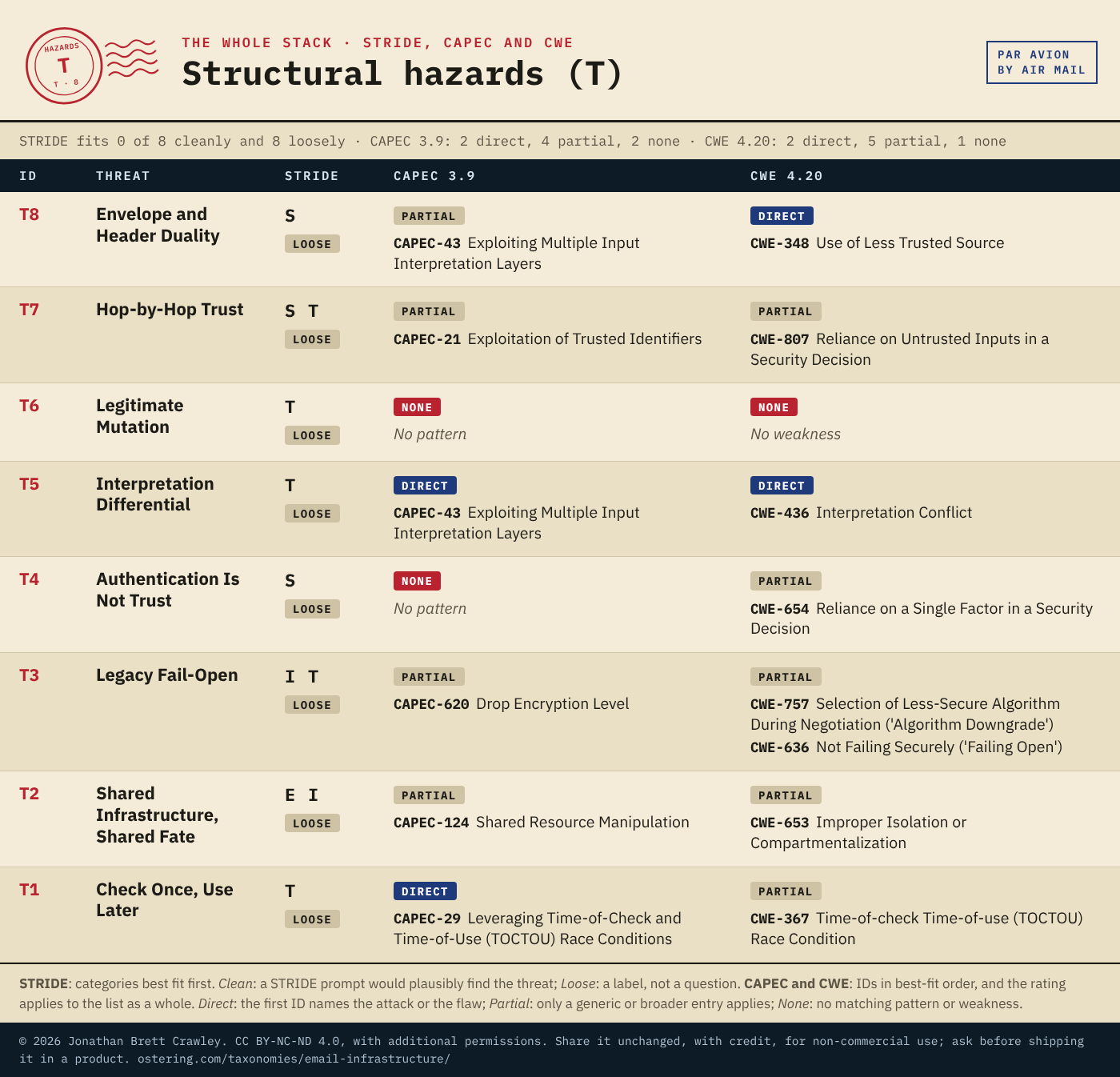
Of the 8 entries here, STRIDE fits none of them cleanly. CAPEC 3.9 has a pattern that describes 2 of them directly, only a generic parent pattern for 4, and nothing for 2. CWE 4.20 names the weakness directly for 2, has only a broader weakness for 5, and nothing for 1. The table below gives the mapping entry by entry, with the names of the CAPEC patterns and CWE weaknesses; what the mapping shows across the whole taxonomy is in Mapping the Email Threat Taxonomy to STRIDE, CAPEC and CWE. The Excel, SKOS and STIX downloads carry the same mapping as text.
← Operations and storage (OP) · Email infrastructure overview
© 2026 Jonathan Brett Crawley. Licensed under CC BY-NC-ND 4.0 with additional permissions: see the licence on the email infrastructure overview.