MIME and S/MIME (MI)
Taxonomies › Email infrastructure › MIME and S/MIME
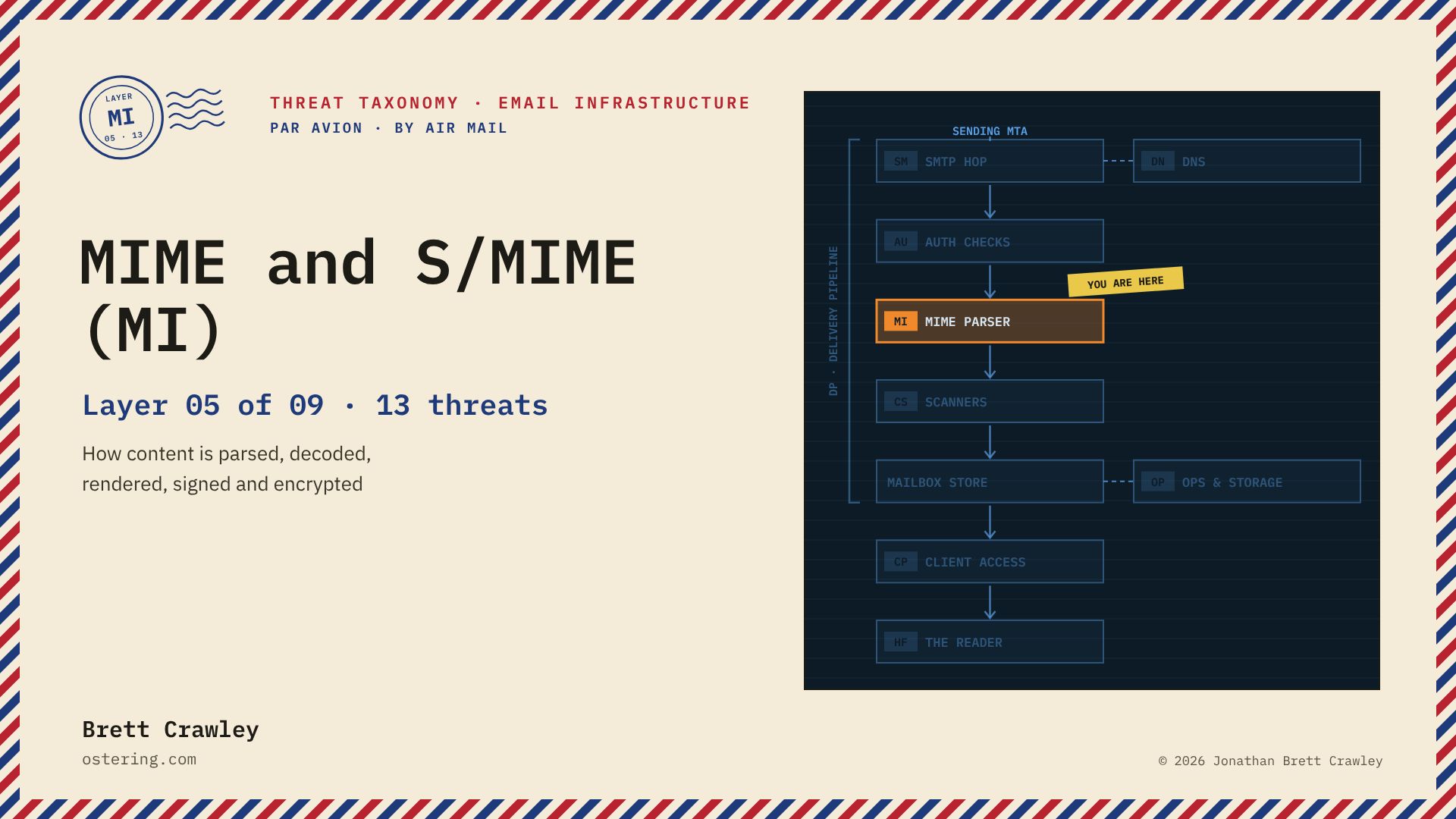
Layer 05 of 09 · 13 threats · prefix MI
Every component that handles a message should interpret it the same way, and most content attacks live where they do not. These entries cover how content is parsed, decoded, rendered, signed and encrypted.
Scope: How content is parsed, decoded, rendered, signed and encrypted.
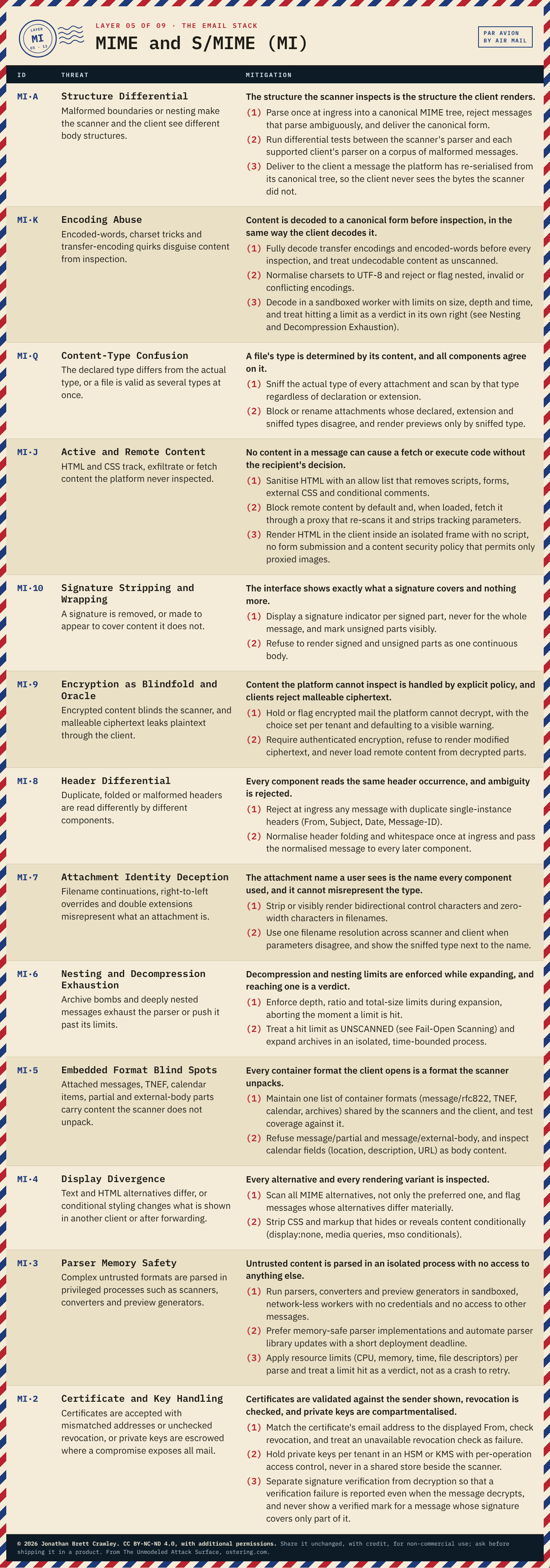
Text version: every entry on this page is in the PDF and Excel downloads on the overview page, where it can be searched and copied.
The threats
- MI·A Structure Differential
- MI·K Encoding Abuse
- MI·Q Content-Type Confusion
- MI·J Active and Remote Content
- MI·10 Signature Stripping and Wrapping
- MI·9 Encryption as Blindfold and Oracle
- MI·8 Header Differential
- MI·7 Attachment Identity Deception
- MI·6 Nesting and Decompression Exhaustion
- MI·5 Embedded Format Blind Spots
- MI·4 Display Divergence
- MI·3 Parser Memory Safety
- MI·2 Certificate and Key Handling
Where this layer touches others
- MIME and delivery pipeline: MIME is how a message is interpreted. The pipeline is whether and when it is inspected.
STRIDE, CAPEC and CWE
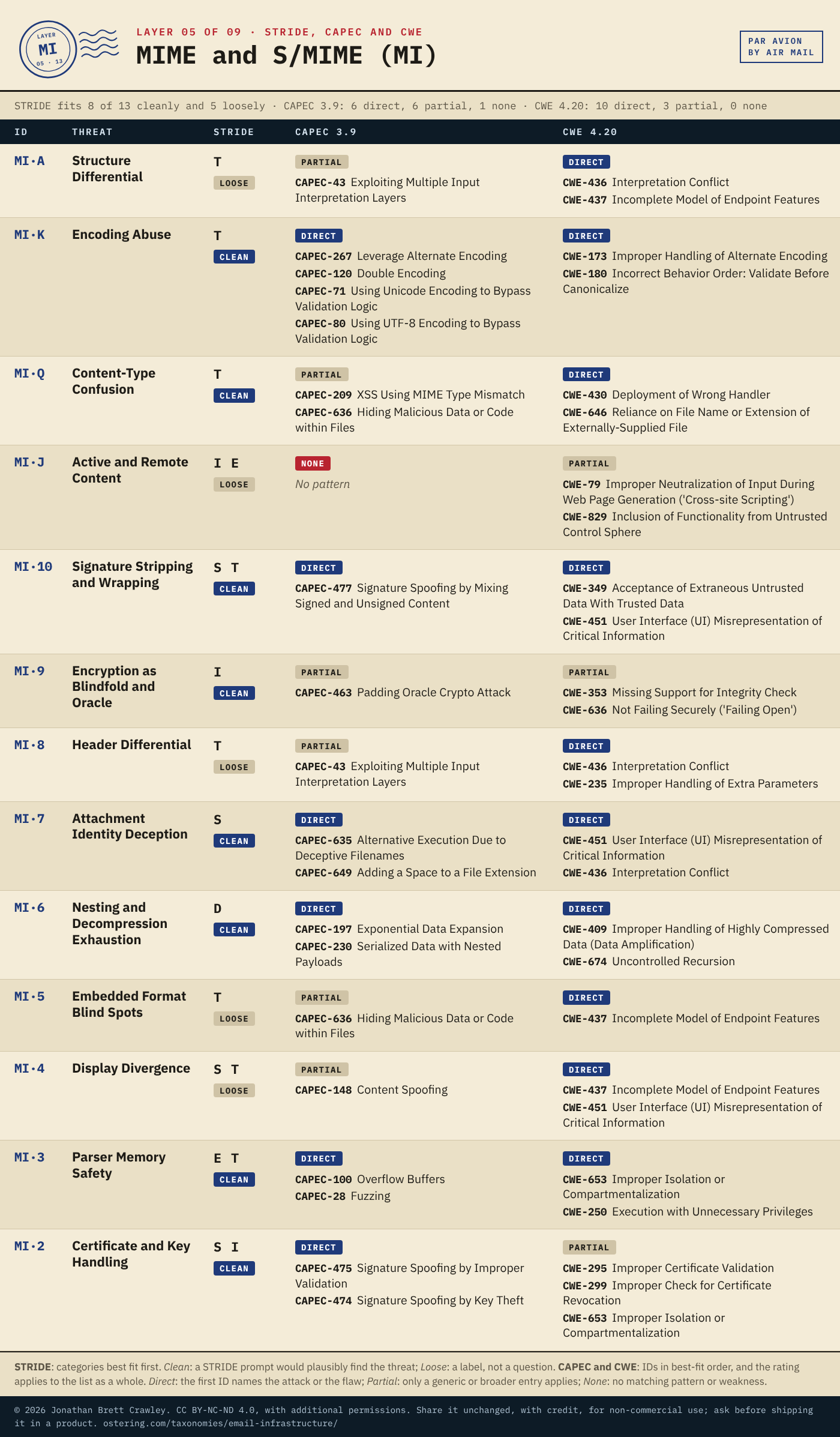
Of the 13 entries here, STRIDE fits 8 cleanly and 5 only loosely. CAPEC 3.9 has a pattern that describes 6 of them directly, only a generic parent pattern for 6, and nothing for 1. CWE 4.20 names the weakness directly for 10, has only a broader weakness for 3,. The table below gives the mapping entry by entry, with the names of the CAPEC patterns and CWE weaknesses; what the mapping shows across the whole taxonomy is in Mapping the Email Threat Taxonomy to STRIDE, CAPEC and CWE. The Excel, SKOS and STIX downloads carry the same mapping as text.
← SMTP (SM) · Email infrastructure overview · DNS layer (DN) →
© 2026 Jonathan Brett Crawley. Licensed under CC BY-NC-ND 4.0 with additional permissions: see the licence on the email infrastructure overview.