Threat Taxonomies
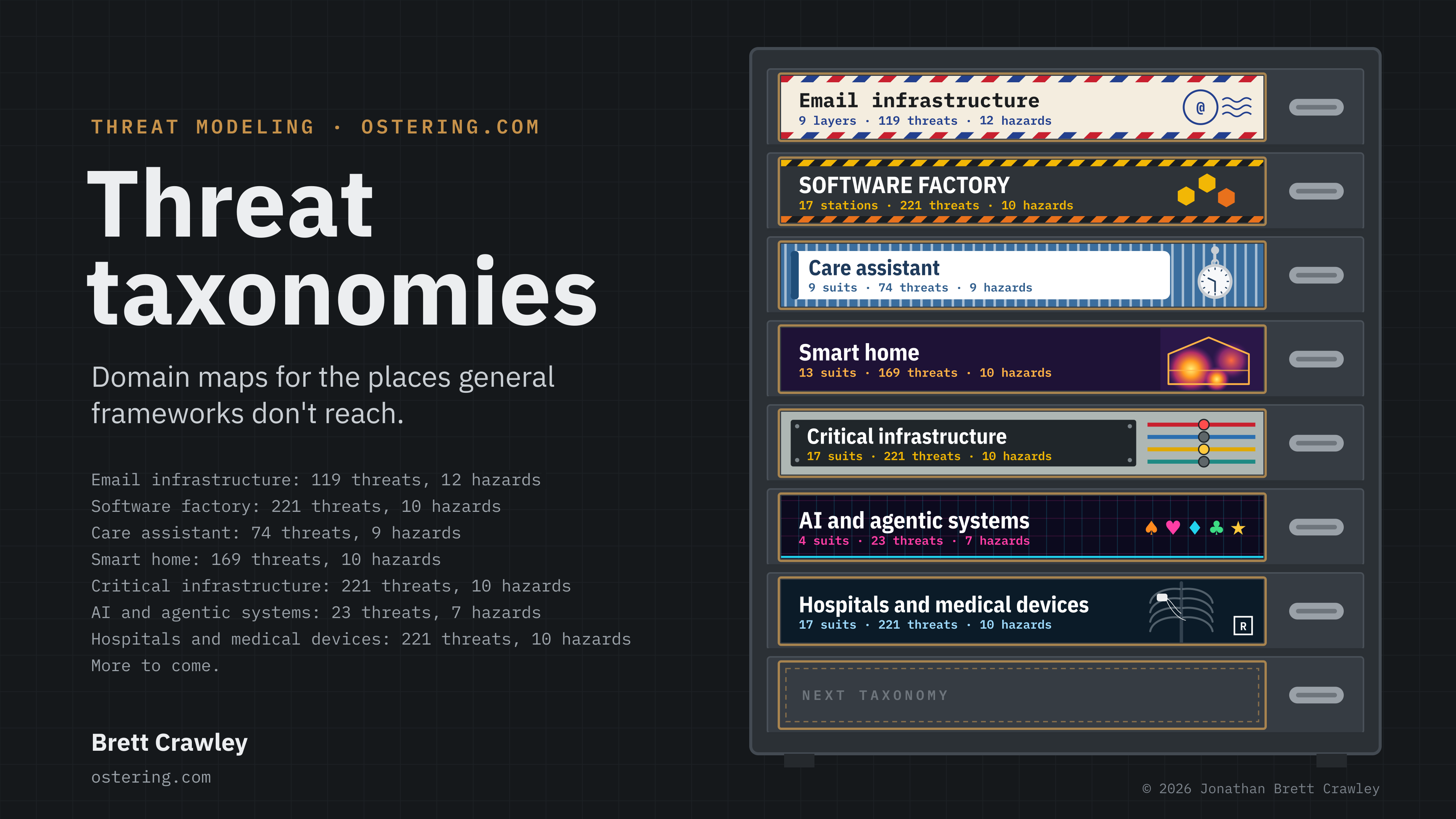
General-purpose frameworks such as STRIDE tell you what kind of thing went wrong. A domain taxonomy tells you where to look. These are threat taxonomies for seven areas that the general frameworks reach only partly: the machinery that delivers email, the software factory that builds and ships software, the systems that watch over someone at home, the smart home, the critical infrastructure a country runs on, AI and agentic systems, and hospitals and their medical devices. Together they hold 1,049 threats and 64 structural hazards.
Each entry states a threat as a property of a component or a design decision, the principle a sound design follows, and two to four concrete design measures. Each taxonomy is the reference for one of my threat modeling card games, and shares its references with the game.
Email infrastructure
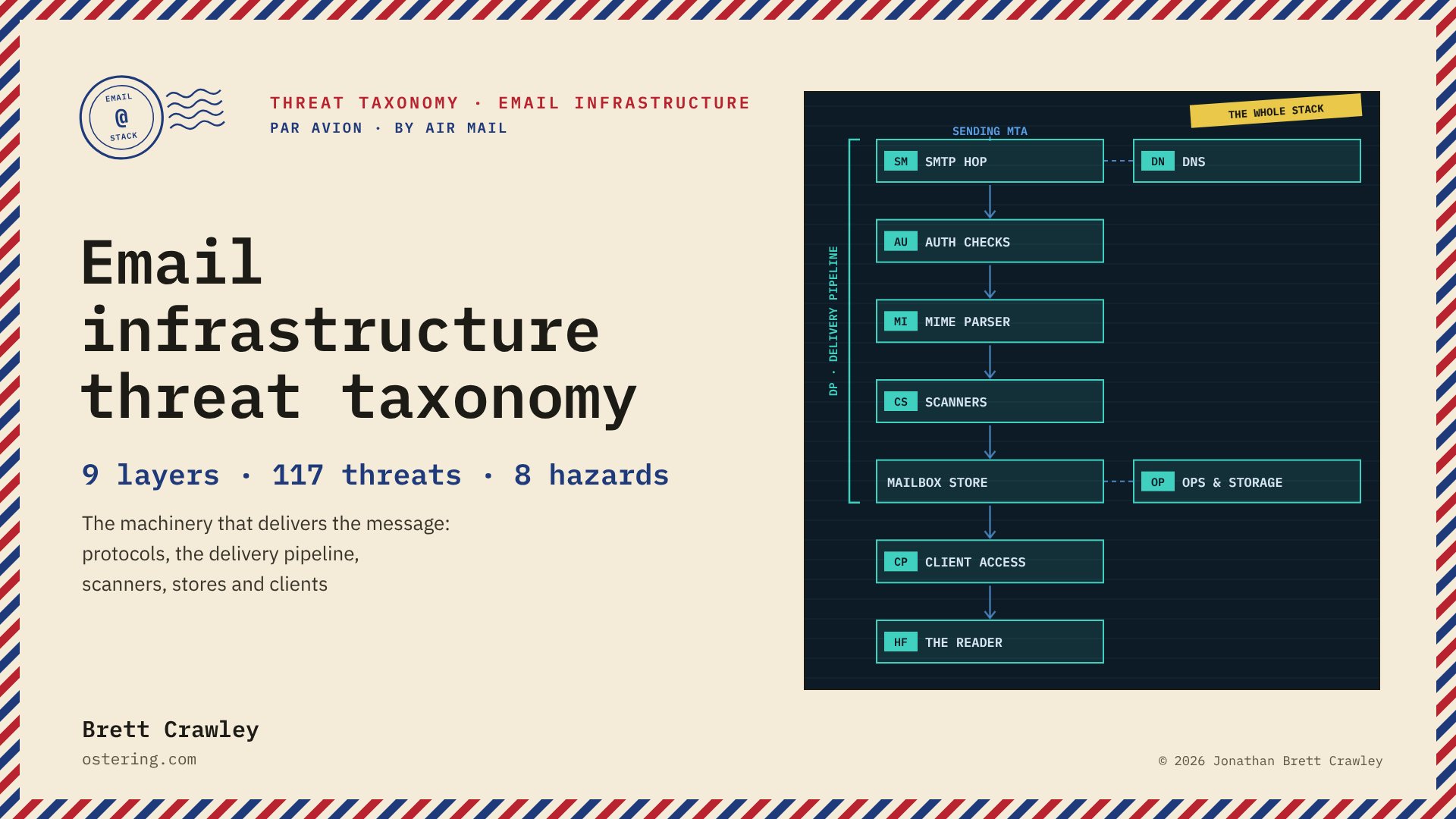
117 threats across nine layers of the email stack, plus 9 structural hazards. The SMTP conversation, sender authentication, DNS, MIME, the delivery pipeline, content scanners, the human-facing layer, client protocols, and operations and storage. The reference for the card game Elevation of Email Flow.
Open the email infrastructure taxonomy · Read the article
Software factory
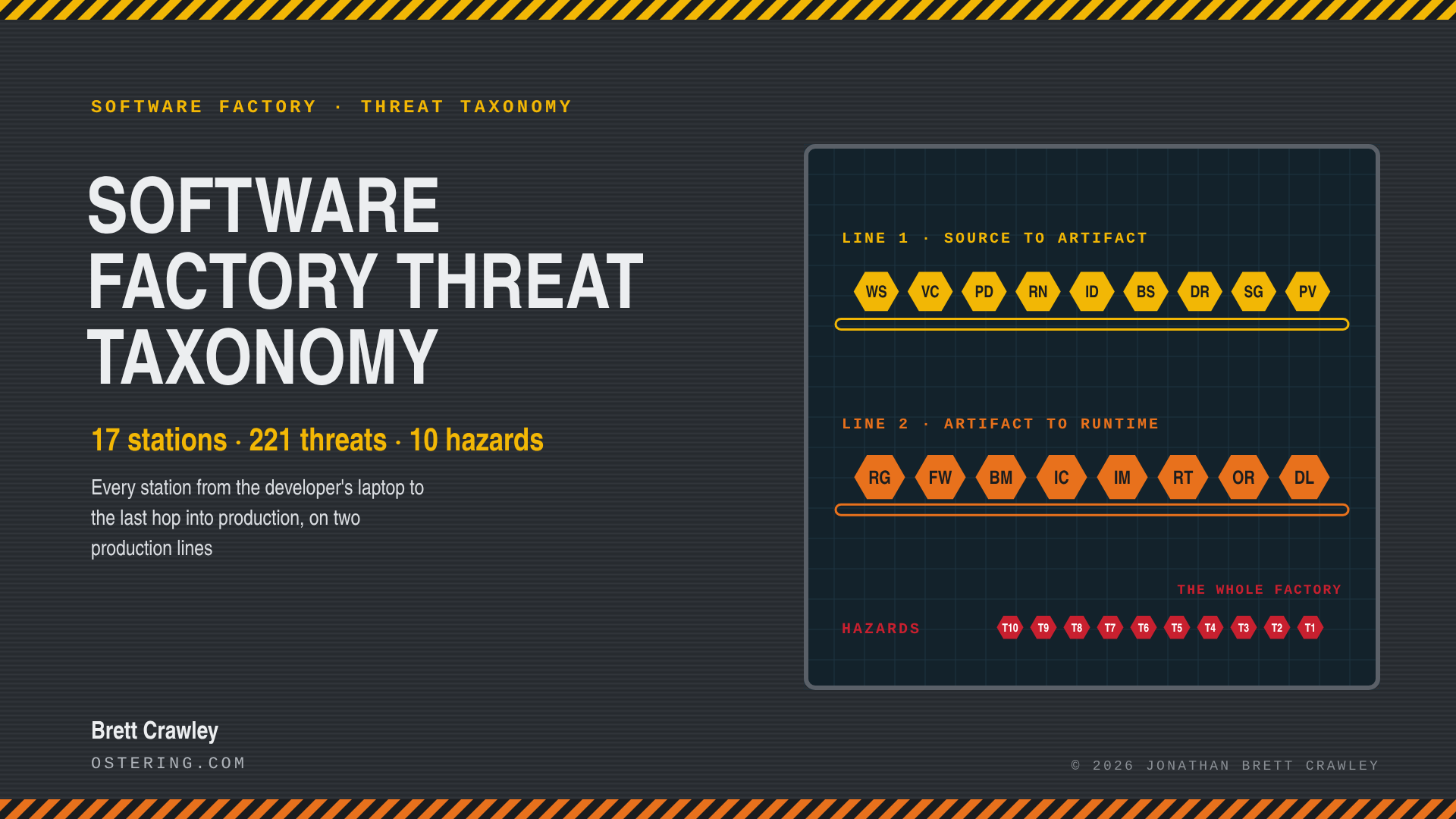
221 threats at 17 stations of the software factory, plus 10 structural hazards. From the developer’s laptop and its agents to the last hop into production, including the security controls themselves. The reference for the card game Software Factory.
Open the software factory taxonomy · Read the article
Care assistant
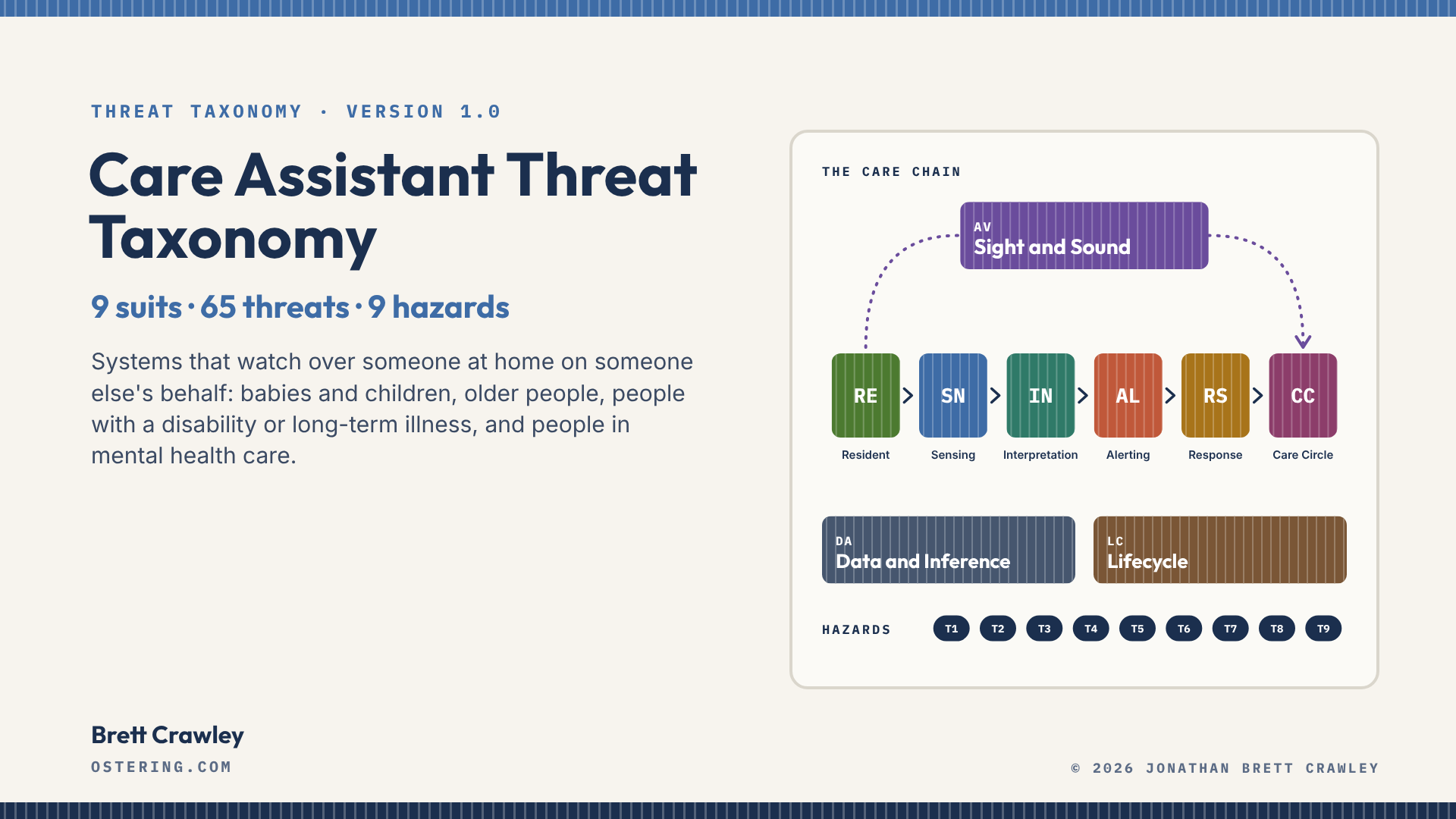
74 threats in nine suits along the chain of care, plus 9 structural hazards. Baby monitors, personal alarms, cameras and monitoring under a care plan: the devices, the monitoring service, the care circle and the person being watched, with mappings to LINDDUN as well as STRIDE. The reference for the card game Elevation of Care.
Open the care assistant taxonomy · Read the article
Smart home
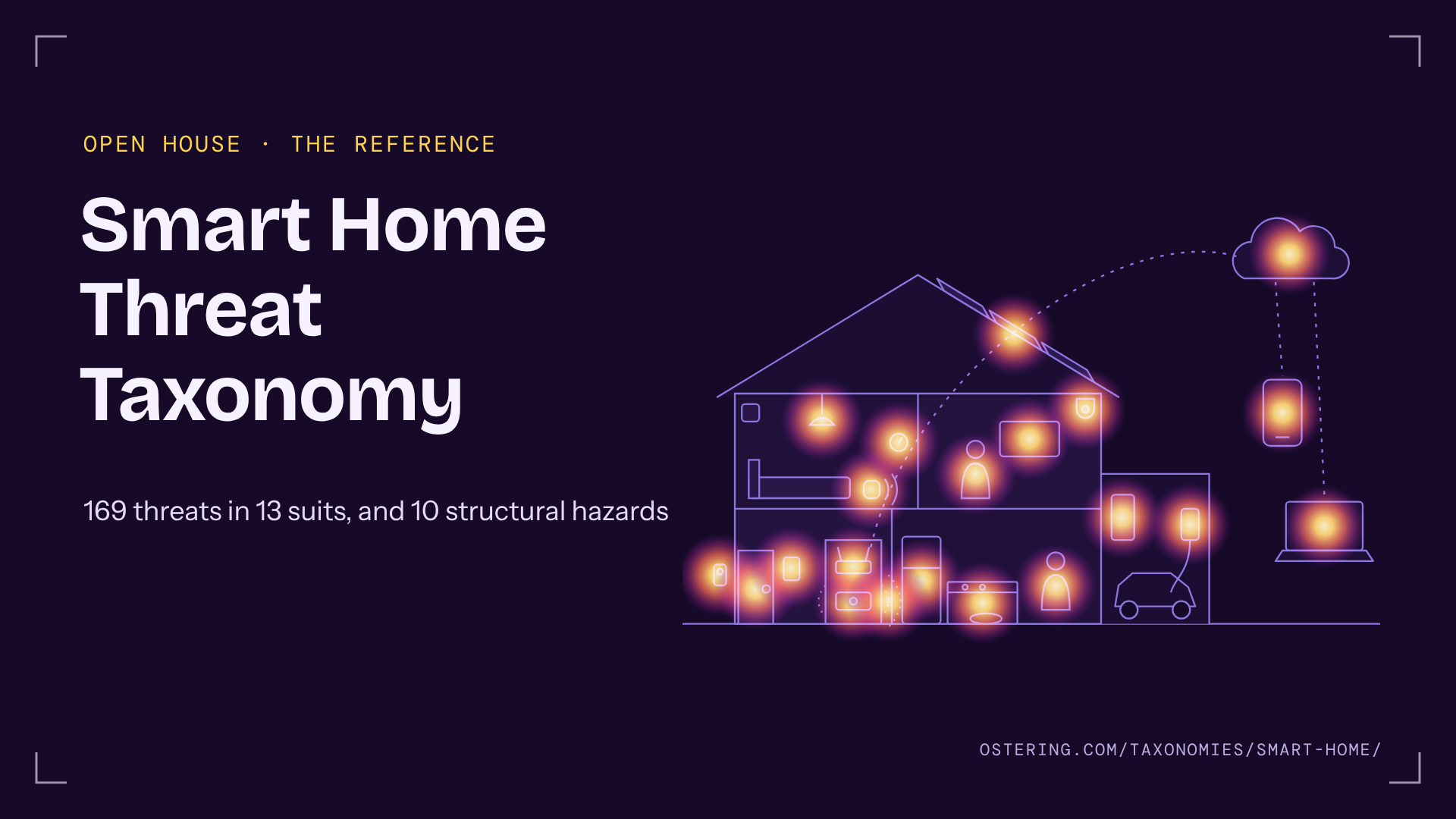
169 threats in 13 suits across the connected home, plus 10 structural hazards. Hubs and bridges, radio and mesh, domotics, cameras and doorbells, alarms and locks, appliances, energy, the home network, the vendor cloud, remote control, voice and automations, the household, and the lifecycle of a home that changes hands. The reference for the card game Open House.
Critical infrastructure
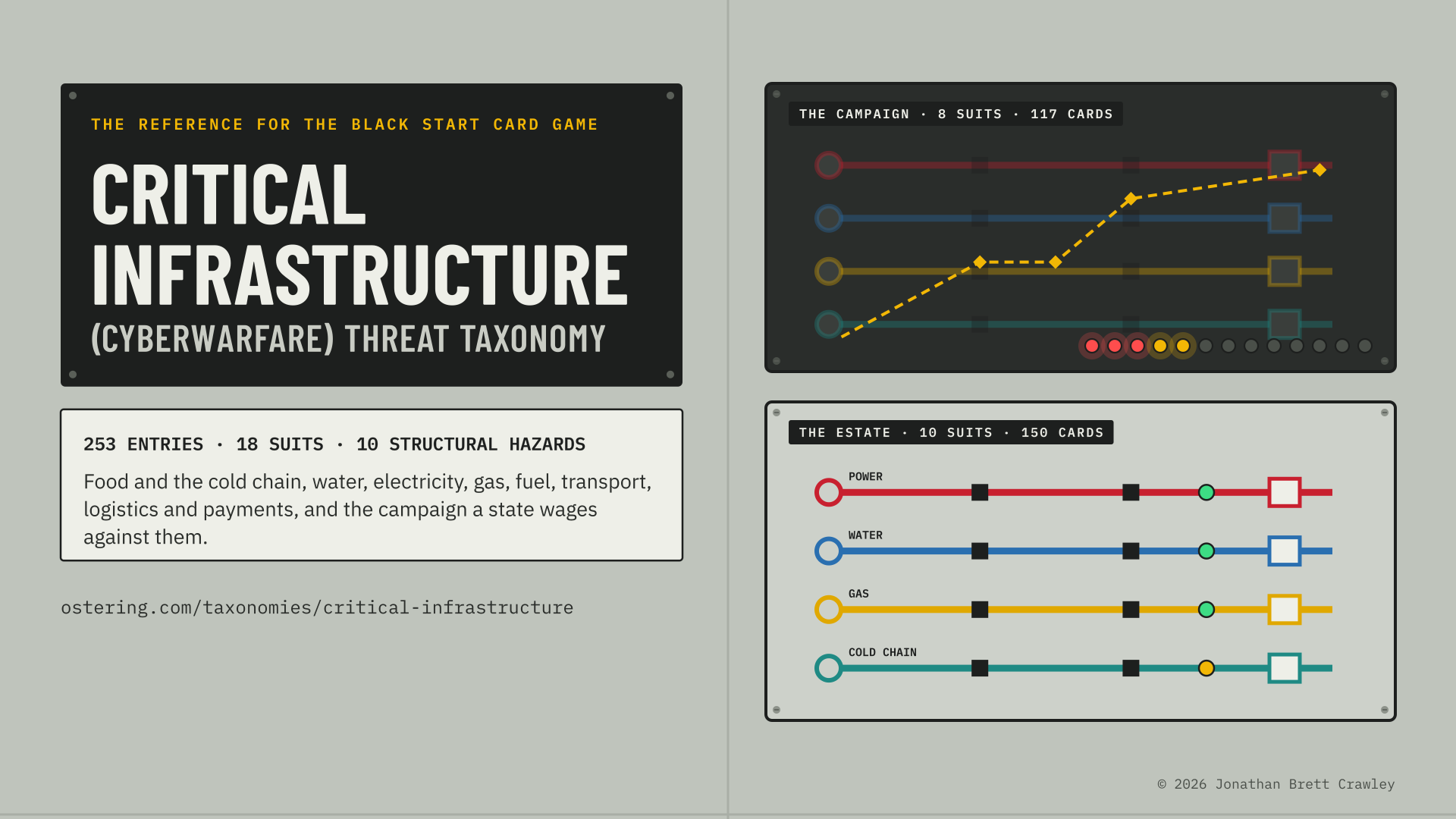
223 threats in 17 suits, plus 10 structural hazards, for essential services facing a state adversary. Food and the cold chain, water, electricity, gas, fuel, transport, logistics and payments, and the campaign against them: reconnaissance, pre-positioning, scale and timing, recovery denial, cascades between sectors, and deniability. The reference for the card game Black Start.
Open the critical infrastructure taxonomy
AI and agentic systems
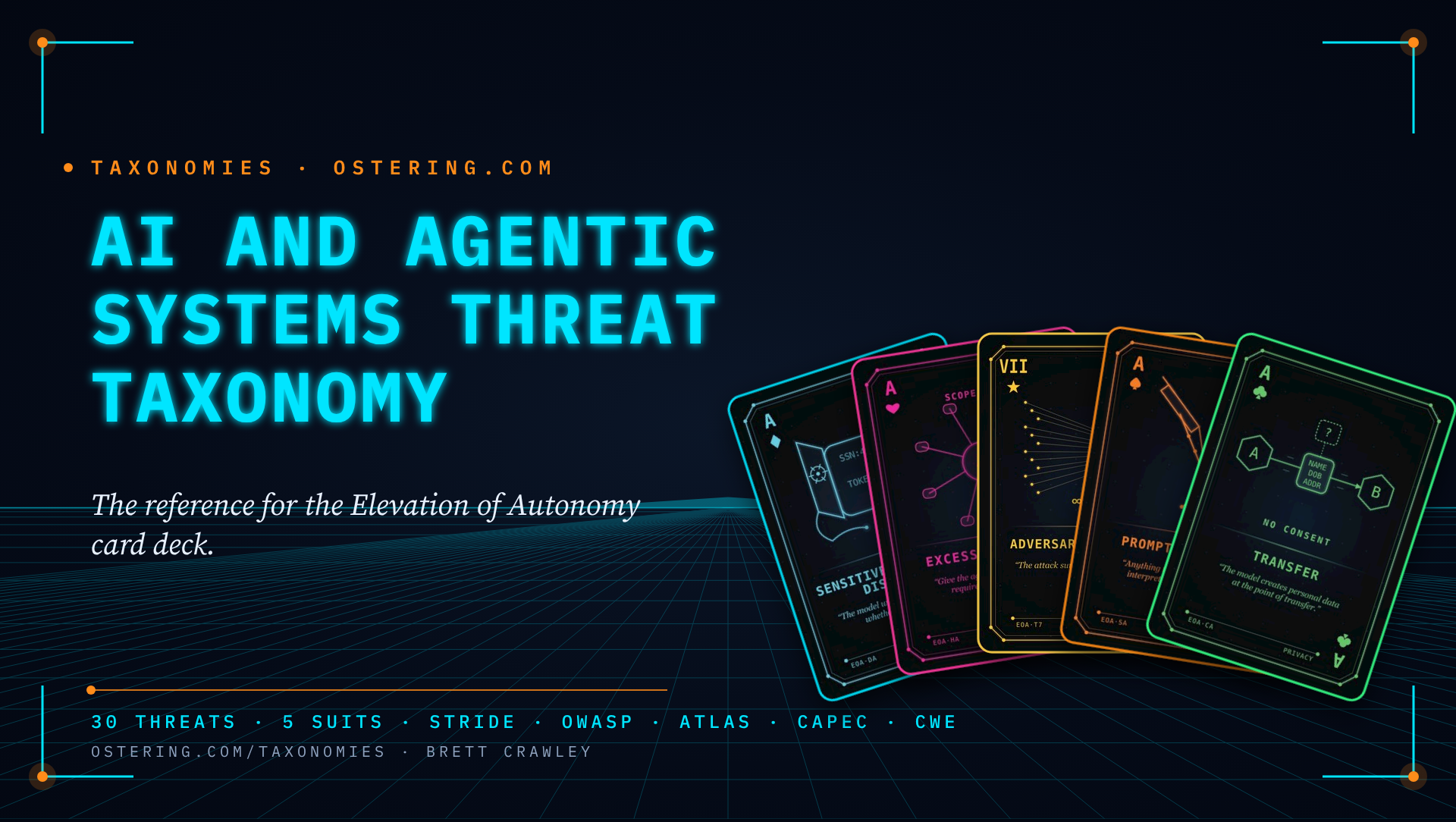
23 threats in four suits, plus 7 structural hazards. Adversarial attacks, autonomy, data and privacy in AI, LLM and agentic systems, with each card’s mitigation prompts and mappings to OWASP and MITRE ATLAS as well as STRIDE, CAPEC and CWE. The IDs are the ones printed on the cards, such as EOA·SA. The reference for the card deck Elevation of Autonomy.
Open the AI and agentic systems taxonomy
Hospitals and medical devices
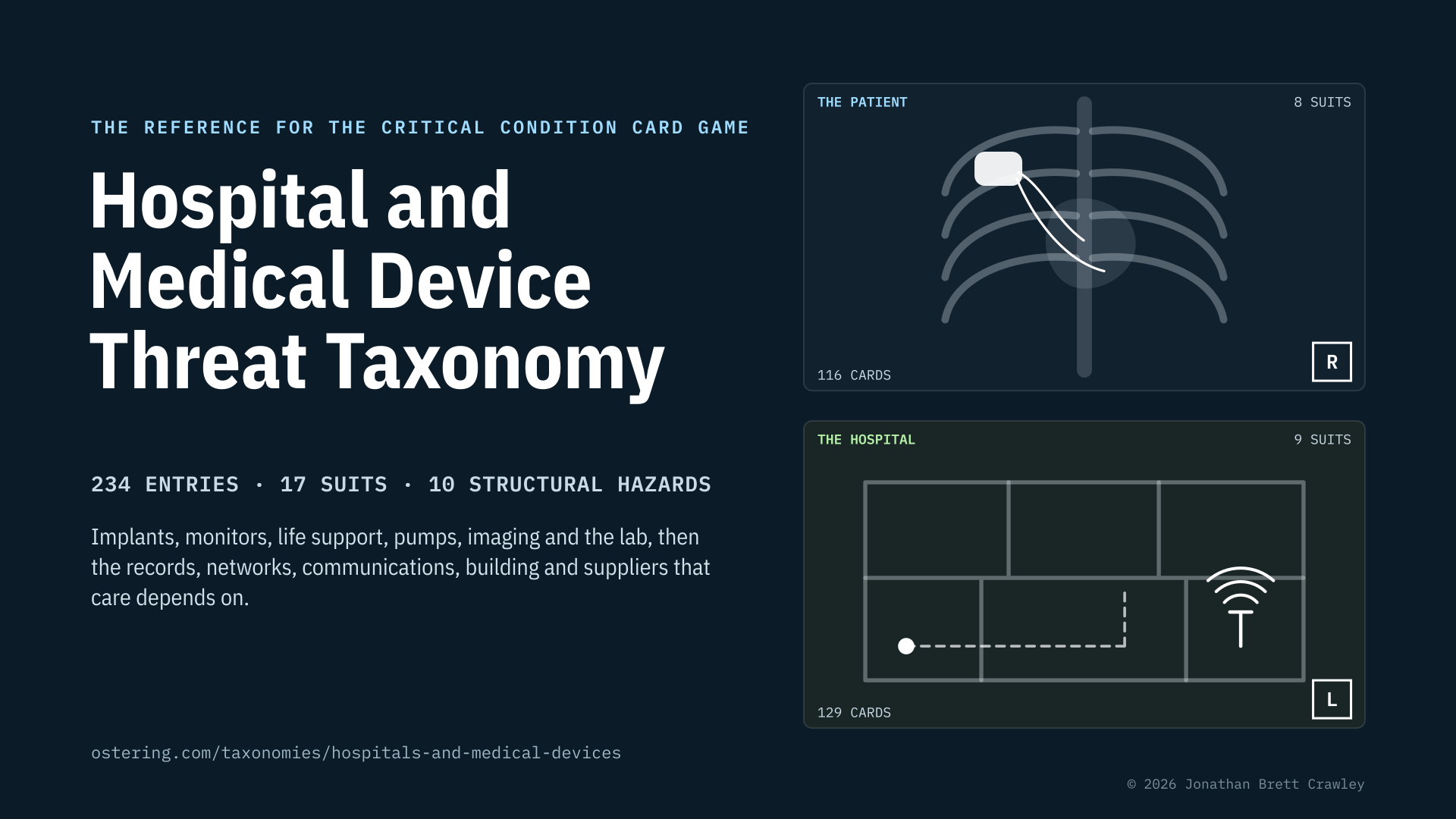
224 threats in 17 suits, plus 10 structural hazards. Implants, patient monitors, ventilators, infusion pumps, imaging and radiotherapy, the laboratory and clinical AI, then the records, integration, networks, clinical and emergency communications, the building, suppliers and downtime that care depends on. Mapped to LINDDUN, MITRE EMB3D and the MDS2 security capabilities as well as STRIDE, CAPEC, CWE and ATT&CK. The reference for the card game Critical Condition.
Open the hospitals and medical devices taxonomy
Formats and licence
Each taxonomy has a page per layer, station or suit, and downloads in four formats: a PDF to read and print, an Excel workbook to work in, a SKOS (JSON-LD) file for linked data, and a STIX 2.1 bundle for security tools. Each overview page lists them.
Unless its overview page says otherwise, each taxonomy is licensed under CC BY-NC-ND 4.0 with additional permissions: you can share it freely for non-commercial purposes, threat model with it (including for paying clients), use it internally and for training in any organisation, and quote entries with credit in paid work. Shipping a taxonomy in a product needs permission. The full terms are on each overview page.