Container Images (IM)
Taxonomies › Software factory › Container Images
Station 14 of 17 · Line 2, Artifact to Runtime · 13 threats · prefix IM
An image freezes a whole operating system and its contents into one artifact, including whatever the build let in. These cards cover base images, Dockerfiles, layers, image builders, tags and digests.
Scope: Base images, Dockerfiles, layers, image builds, tags and digests.
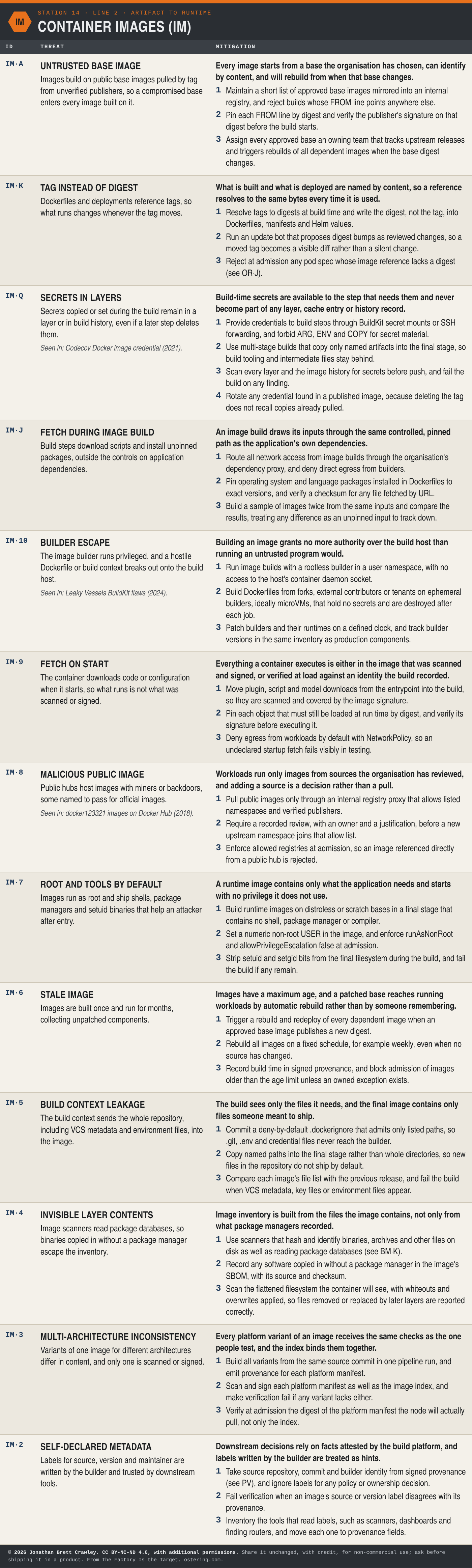
Text version: every entry on this page is in the PDF and Excel downloads on the overview page, where it can be searched and copied.
The threats
- IM·A Untrusted Base Image
- IM·K Tag Instead of Digest
- IM·Q Secrets in Layers
- IM·J Fetch During Image Build
- IM·10 Builder Escape
- IM·9 Fetch on Start
- IM·8 Malicious Public Image
- IM·7 Root and Tools by Default
- IM·6 Stale Image
- IM·5 Build Context Leakage
- IM·4 Invisible Layer Contents
- IM·3 Multi-Architecture Inconsistency
- IM·2 Self-Declared Metadata
Where this station touches others
- Container Images and Container Runtime: the image is what is packaged; the runtime is how it is contained.
Seen in the wild
- IM·Q Secrets in Layers: Codecov Docker image credential (2021).
- IM·10 Builder Escape: Leaky Vessels BuildKit flaws (2024).
- IM·8 Malicious Public Image: docker123321 images on Docker Hub (2018).
Sources for each case are listed on the overview page.
STRIDE, CAPEC and CWE
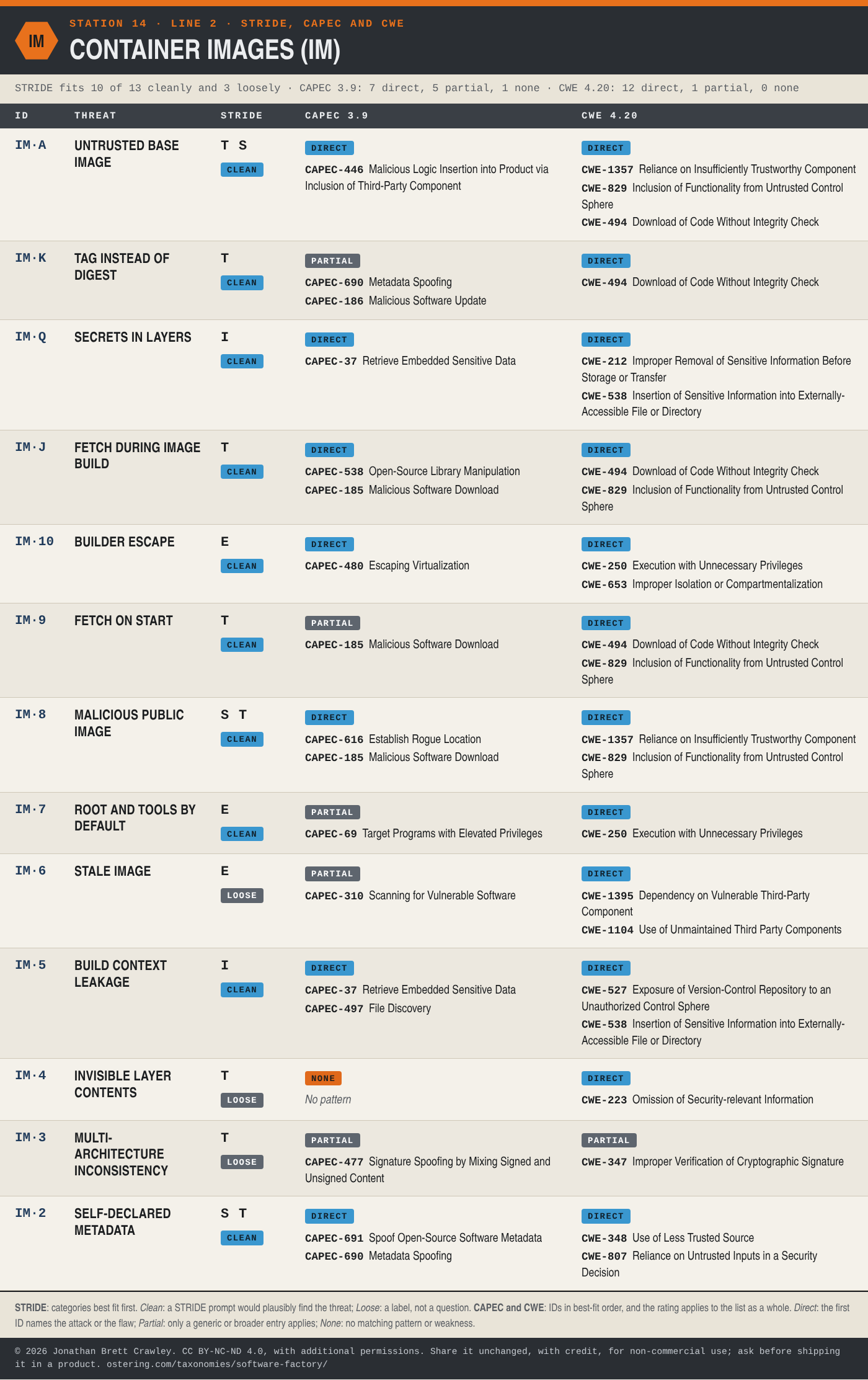
Of the 13 entries here, STRIDE fits 10 cleanly and 3 only loosely. CAPEC 3.9 has a pattern that describes 7 of them directly, only a generic parent pattern for 5, and nothing for 1. CWE 4.20 names the weakness directly for 12, has only a broader weakness for 1,. The table below gives the mapping entry by entry, with the names of the CAPEC patterns and CWE weaknesses; what the mapping shows across the whole taxonomy is in Mapping the Software Factory Threat Taxonomy to STRIDE, CAPEC and CWE. The Excel, SKOS and STIX downloads carry the same mapping as text.
← Infrastructure as Code (IC) · Software factory overview · Container Runtime (RT) →
© 2026 Jonathan Brett Crawley. Licensed under CC BY-NC-ND 4.0 with additional permissions: see the licence on the software factory overview.