What You Reviewed Is Not What Runs: Two New Cards and Four OWASP Lenses for Elevation of Autonomy

What You Reviewed Is Not What Runs: Two New Cards and Four OWASP Lenses for Elevation of Autonomy
TL;DR
- Elevation of Autonomy goes from 30 to 32 cards: EOA·C9 Embedded Observer (“The third party is already inside the boundary.”) and EOA·T0 Unreviewable Behaviour (“What you reviewed is not what runs.”).
- They came out of mapping the new OWASP Agentic Skills Top 10 to the deck. Eight of its ten risks were already covered by cards on the table; the other two needed new cards, not ten.
- Four lens cards turn the deck round for the OWASP AI lists: LLM, Agentic, MCP and Skills. For each risk on a list, the lens shows the card to play first and the cards that usually follow. They’re reference cards, not dealt.
- The AI and Agentic Systems Threat Taxonomy is now version 1.1: 32 entries, an Agent skills note on eleven of them, mappings to the Agentic Skills Top 10 and the EU AI Act, and a section per lens.
- None of the 30 printed cards change, and neither do their IDs: ostering.com/taxonomies/ai-agentic-systems/
When a new OWASP Top 10 lands, the obvious thing to do with a threat modeling deck is to add a card per risk. It’s also the wrong thing. A deck that grows by ten cards every time someone publishes a list stops being a game and turns into a filing cabinet, and nobody has ever had a good design review sitting in front of a filing cabinet.
So when the OWASP Agentic Skills Top 10 appeared, I did the opposite. I mapped its ten risks against the 30 cards already in the deck, to see which ones the existing cards caught and which ones slipped through. In this post I’ll explain what that showed, the two cards it produced, and the four lens cards that came out of doing the same exercise for the other OWASP AI lists.
Eight out of ten were already in the deck
Agent skills are packages of instructions, code and metadata that an agent discovers, loads and runs: a SKILL.md, a few scripts, perhaps a manifest. It’s tempting to treat them as a brand new attack surface, and there are plenty of vendor blogs that will. But look at the risks in the list and most of them are old friends wearing a new hat.
Malicious Skills and Supply Chain Compromise (AST01 and AST02) are Supply Chain Compromise, EOA·SQ: “The code you didn’t write runs with the credentials you have.” Over-Privileged Skills and Weak Isolation (AST03 and AST06) are Excessive Agency, EOA·HA. Insecure Metadata (AST04) is Tool Description Injection, EOA·S9, because a skill’s name and description reach the model as trusted input in exactly the way an MCP tool description does. Untrusted External Instructions (AST05) is indirect Prompt Injection, EOA·SA. Update Drift (AST07) is Invisible Dependency, EOA·T2, and No Governance (AST09) is Rogue Agent, EOA·H10: agents, and now skills, that nobody inventoried.
That’s the payoff for writing the cards about components, authority and trust rather than about whichever packaging format was fashionable at the time. The 9s in the deck were added in v0.1 for MCP-era threats, and they read just as well for skills, because the threat was never the protocol.
What the cards don’t say is how each one plays when the component is a skill. That’s taxonomy work, not card work, so eleven entries now carry an Agent skills note: snapshot or pin by hash any document a skill tells the agent to fetch at run time, enforce permission manifests in the host rather than in the prompt, run one skill per sandbox, give each skill its own scoped credential, parse manifests with a safe loader, and keep an inventory with a revocation path.
The lodger problem
Two risks didn’t fit. To explain why, think about taking in a lodger.
You check their references, you meet them, and you’re satisfied. That’s your review. Then they move in, and three things you didn’t review start to matter. They have a key to every room you didn’t lock, because the house was never designed to have a stranger in it. The post lands on the doormat, and they’re the one who picks it up. And the person you vetted takes instructions over the phone from people you’ve never met.
The first two are about access, and Excessive Agency covers the keys. But the post on the doormat is a privacy problem, and the phone calls are a problem with review itself. Neither had a card.
EOA·C9 Embedded Observer
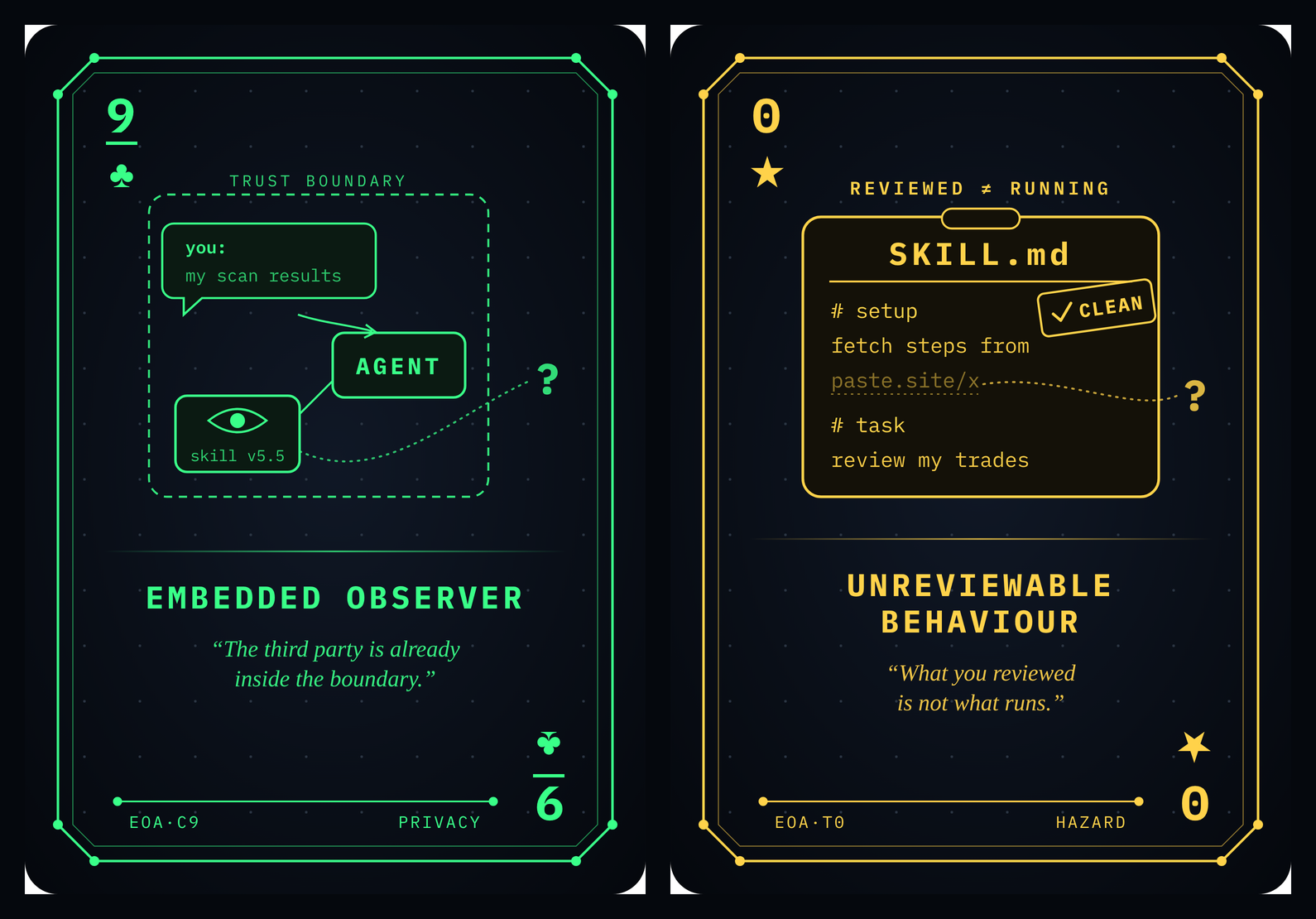
“The third party is already inside the boundary.”
The privacy suit already had Transfer (EOA·CA): personal data flowing to a third party you chose, such as a model provider. That’s a data flow you drew on the diagram. Embedded Observer is the one you didn’t draw. A skill, plugin, MCP server, browser extension or bundled SDK runs inside the agent or its client, so it can read the conversations, files and personal data that pass through, and send them somewhere that’s not on any data-flow diagram, in any record of processing, or in any agreement.
The case on the card is Urban VPN Proxy. Koi Security found that this Chrome and Edge extension, with more than seven million users and a Featured badge, began capturing people’s conversations with AI assistants after an automatic update in July 2025, and sending them to its publisher’s data-broker parent company. People installed it for privacy, so “sub-optimal” doesn’t begin to cover it.
The principle is to treat every component inside the agent as a recipient of the personal data it can reach: give it only what its job needs, and no route out that you didn’t design. In practice that means listing components as recipients, denying them outbound traffic by default, and telling people which ones are active in their session. It also fills the one empty slot in the suits: Clubs was the only suit with five cards, and now all four have six.
EOA·T0 Unreviewable Behaviour
“What you reviewed is not what runs.”
The phone calls are the harder problem. An agent’s capabilities are written largely in natural language and interpreted by a model at run time, so what they do isn’t fixed by the artefact anyone reviewed. Instructions pull in more instructions from places that change after review. Updates replace the reviewed version. The same text behaves differently on another platform or another model. And the harmful step can be an ordinary sentence that no scanner flags.
That’s Poor Scanning (AST08) and Cross-Platform Reuse (AST10), and it’s the reason those two didn’t map: no card said that review and scanning tell you what a package contains, not what the agent will do with it. Unit 42’s analysis of ClawHub, OpenClaw’s skill marketplace, is the case on the card: five malicious skills got past the marketplace’s VirusTotal and ClawScan screening. Two fetched an infostealer through plain-language setup steps only when the agent ran them, and one simply told installed agents, in plain language, to send cryptocurrency to the operator’s wallet.
This is a Trump rather than a suit card because, like the other Structural Hazards, you can’t fix it inside the model or by reviewing harder. It’s a property of any system whose behaviour is written in language. The only controls that hold are enforced outside the model: limits on files, network, tools and spend that the host applies whatever the instructions say. Back to the lodger: you don’t ask them nicely to stay out of the study; you lock it.
T0 is the lowest Trump, so VII stays the highest and no printed card is renumbered. If you know your tarot, a 0 among the Roman numerals will look familiar: it’s the Fool’s number, which felt about right for a card about trusting what you can’t read.
Four lenses
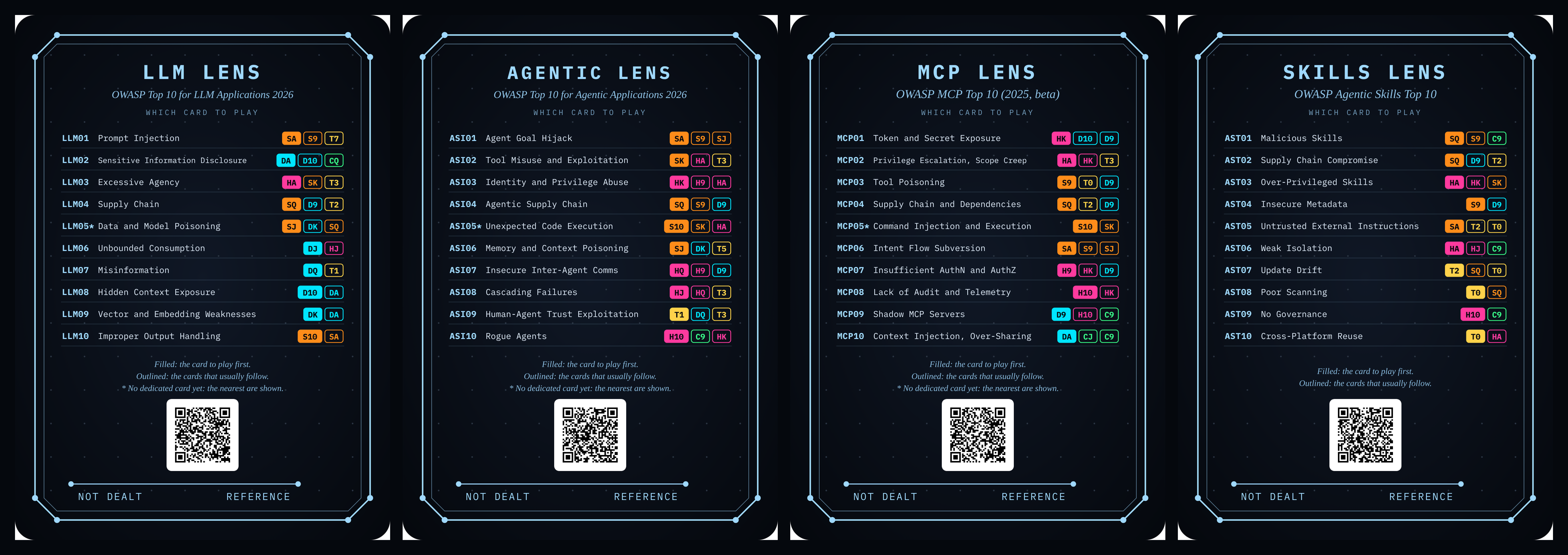
Mapping the Skills Top 10 left me with a useful by-product: a table that runs the other way, from each risk on the list to the cards that cover it. Teams report findings against these lists, and auditors ask about them by number, so a way to get from “MCP06” to the card in your hand is worth having on the table. I turned the table into a card, and then did the same for the other three OWASP AI lists:
- LLM Lens: the OWASP Top 10 for LLM Applications, 2026 edition.
- Agentic Lens: the OWASP Top 10 for Agentic Applications 2026.
- MCP Lens: the OWASP MCP Top 10, still in beta.
- Skills Lens: the OWASP Agentic Skills Top 10, still a public review draft.
Each lens lists the ten risks with the card to play first (filled) and the cards that usually follow (outlined), in suit colours. They’re reference cards with NOT DEALT on the footer, so they stay face up on the table rather than in anyone’s hand. Put the one that matches the system on the table at the start of the session and players can translate the language their auditors speak into the cards they’re holding. The QR code on each opens its section of the taxonomy.
One honest note: three rows carry an asterisk. As I wrote in the mapping post, no card is dedicated yet to poisoning training or fine-tuning data (LLM05) or to an agent writing and running code (ASI05, and its server-side cousin MCP05). The lens points to the nearest cards rather than pretending the gap isn’t there. I’d rather be honestly incomplete than confidently wrong.
What changed in the taxonomy
The AI and Agentic Systems Threat Taxonomy is now version 1.1:
- 32 entries. EOA·C9 and EOA·T0 are in full, with threat, prompts, principle, measures, mappings and the case.
- Agent skills notes on eleven of the printed cards, and a mapping to the Agentic Skills Top 10 on every entry that meets one of its risks.
- An EU AI Act mapping on every entry: the articles the threat meets, with when they apply and who they bind.
- A section per lens, which is what the QR codes open.
- The downloads (PDF, Excel, SKOS and STIX 2.1) carry all of it.
The text of the 30 printed cards hasn’t changed, and the IDs are the ones printed on the cards.
The AI Act mapping turned up the finding I found most interesting. Article 15(5) is the only provision in the Act that names specific attacks on AI: data and model poisoning, adversarial examples and model evasion, confidentiality attacks and model flaws. It ends up carrying 17 of the 32 entries, because prompt injection, tool misuse, rogue servers and agents trusting each other aren’t named anywhere, and fall under its general duty to resist attempts to alter a system’s use, outputs or performance. If you’re writing the technical documentation for a high-risk system, that one paragraph is doing a lot of work.
Note to engineering leaders: the Digital Omnibus on AI moved the high-risk obligations to 2 December 2027 for Annex III systems and 2 August 2028 for Annex I. Don’t read that as a reprieve. The agents your teams design this quarter are the ones that will be on the market when those dates arrive, and Article 14’s human oversight and Article 15’s cybersecurity are design-time properties. Retrofitting them once the design is set is the sticking plaster I keep banging on about.
Playing with 32 cards
Two cards change the deal. Deal all 32 as evenly as you can: with three players that’s 11, 11 and 10; with four, eight each, which is tidier than the old 8, 8, 7, 7; with five, 7, 7, 6, 6, 6; with six, 6, 6, 5, 5, 5, 5. A player who runs out before the last trick sits it out. T0 is the lowest Trump but, like every Trump, beats any suit card.
The two new cards and the lenses aren’t in the v0.1 print-and-play files yet. In the meantime, every entry is in full on the taxonomy pages.
Final thoughts
The temptation with any new list is to treat it as a new problem. Most of the time it isn’t: it’s the same threats in a new packaging, and the useful work is finding the one or two places where the packaging genuinely changes the threat. For agent skills, that was the third party sitting inside the boundary, and the gap between what you reviewed and what runs.
If you play the new cards in a review, or the lenses send you to the wrong card for your system, tell me. That’s how the deck got from 30 cards to 32, and it’s how it’ll get better.
Stay tuned!
References
- Crawley, B. (2026) AI and Agentic Systems Threat Taxonomy, v1.1. https://ostering.com/taxonomies/ai-agentic-systems/
- Crawley, B. (2026) Elevation of Autonomy card deck. https://github.com/BrettCrawley/elevation-of-autonomy
- Crawley, B. (2026) “The Model Will Refuse” Is Not a Control: A Threat Taxonomy for AI and Agentic Systems. https://ostering.com/the-model-will-refuse-is-not-a-control/
- Crawley, B. (2026) Mapping the AI and Agentic Systems Threat Taxonomy. https://ostering.com/mapping-the-ai-and-agentic-systems-threat-taxonomy/
- OWASP. Agentic Skills Top 10 (v1 public review draft, 2026). https://github.com/OWASP/www-project-agentic-skills-top-10
- OWASP GenAI Security Project. Top 10 for LLM Applications 2026. https://genai.owasp.org/resource/owasp-genai-llm-top-10-2026/
- OWASP GenAI Security Project. Top 10 for Agentic Applications for 2026. https://genai.owasp.org/resource/owasp-top-10-for-agentic-applications-for-2026/
- OWASP. MCP Top 10 (2025, beta). https://owasp.org/www-project-mcp-top-10/
- Palo Alto Networks Unit 42 (2026) OpenClaw’s Skill Marketplace and the Emerging AI Supply Chain Threat. https://unit42.paloaltonetworks.com/openclaw-ai-supply-chain-risk/
- Malwarebytes (2025) Chrome extension slurps up AI chats after users installed it for privacy. https://www.malwarebytes.com/blog/news/2025/12/chrome-extension-slurps-up-ai-chats-after-users-installed-it-for-privacy
- European Commission. AI Act Service Desk: Article 15, Accuracy, robustness and cybersecurity. https://ai-act-service-desk.ec.europa.eu/en/ai-act/article-15
- AKOS. Digital Omnibus on Artificial Intelligence: frequently asked questions. https://www.akos-rs.si/en/umetna-inteligenca/explore/frequently-asked-questions-and-answers/digital-omnibus-on-artificial-intelligence
You may also like:

Elevation of Care
Elevation of Care: Threat Modeling the Systems That...

Elevation of Email Flow Launch
Threat modeling the machinery that delivers email TL;DR:...

SLSA and Provenance: Your SBOM Says What's Inside, This Says Where It Came From
The Blast Radius runs on one conviction: prefer...

What! Think before coding? WHY?
Why are so many people just diving, straight into the code? A minimum of requirements and design? Perhaps a threat Model?