Energy
Smart Home Threat Taxonomy › Energy (OPH-EN)
Solar inverters, home batteries, EV chargers, heat pumps as flexible loads, smart meters and the energy manager that plays them against the tariff. Connected energy devices act on the grid as well as on the house.
Where it sits in the house
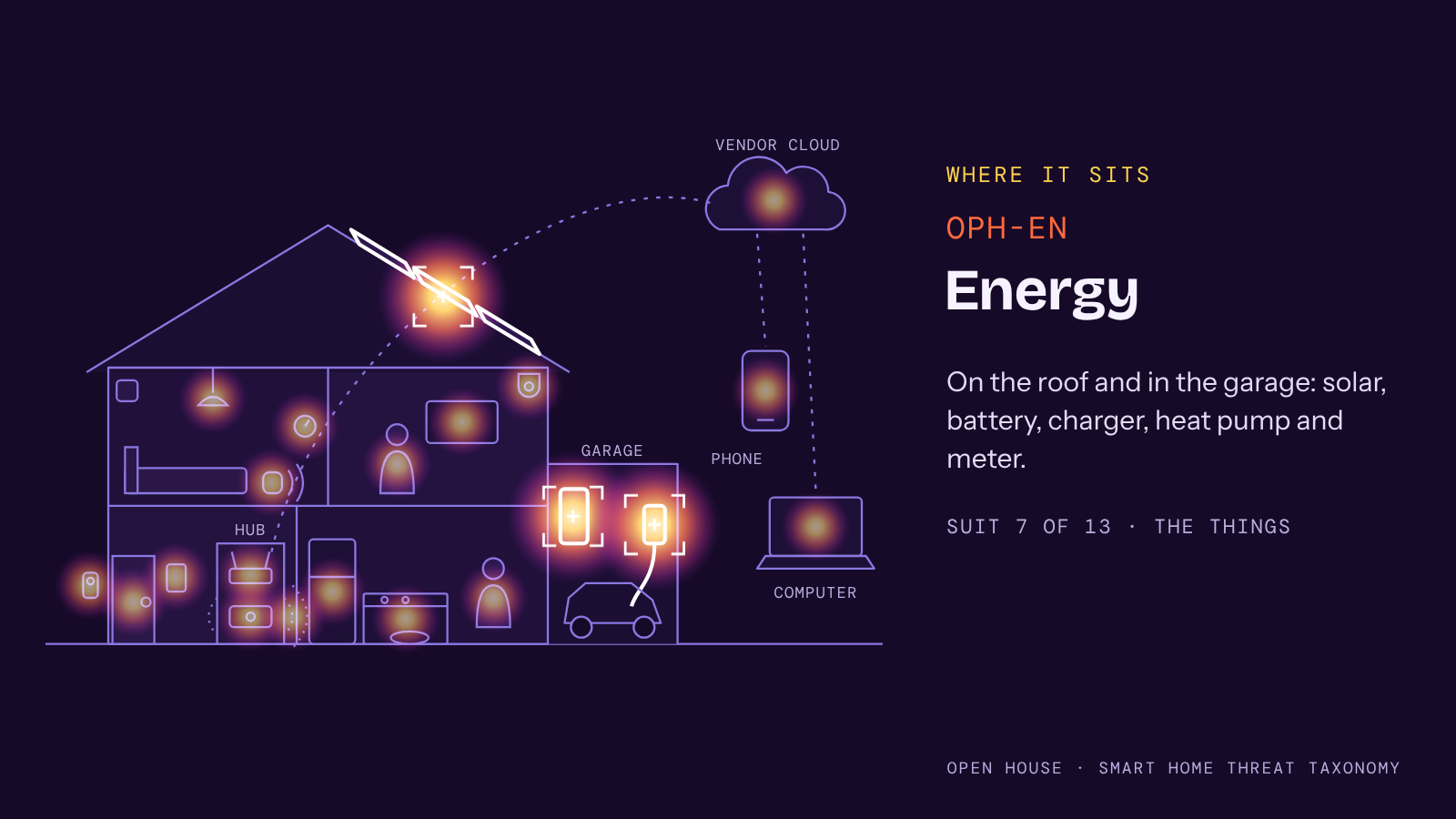
The Energy suit sits on the roof and in the garage: solar, battery, charger, heat pump and meter. It is suit 7 of 13, in the Things deck.
The table
Mappings
Entries in text
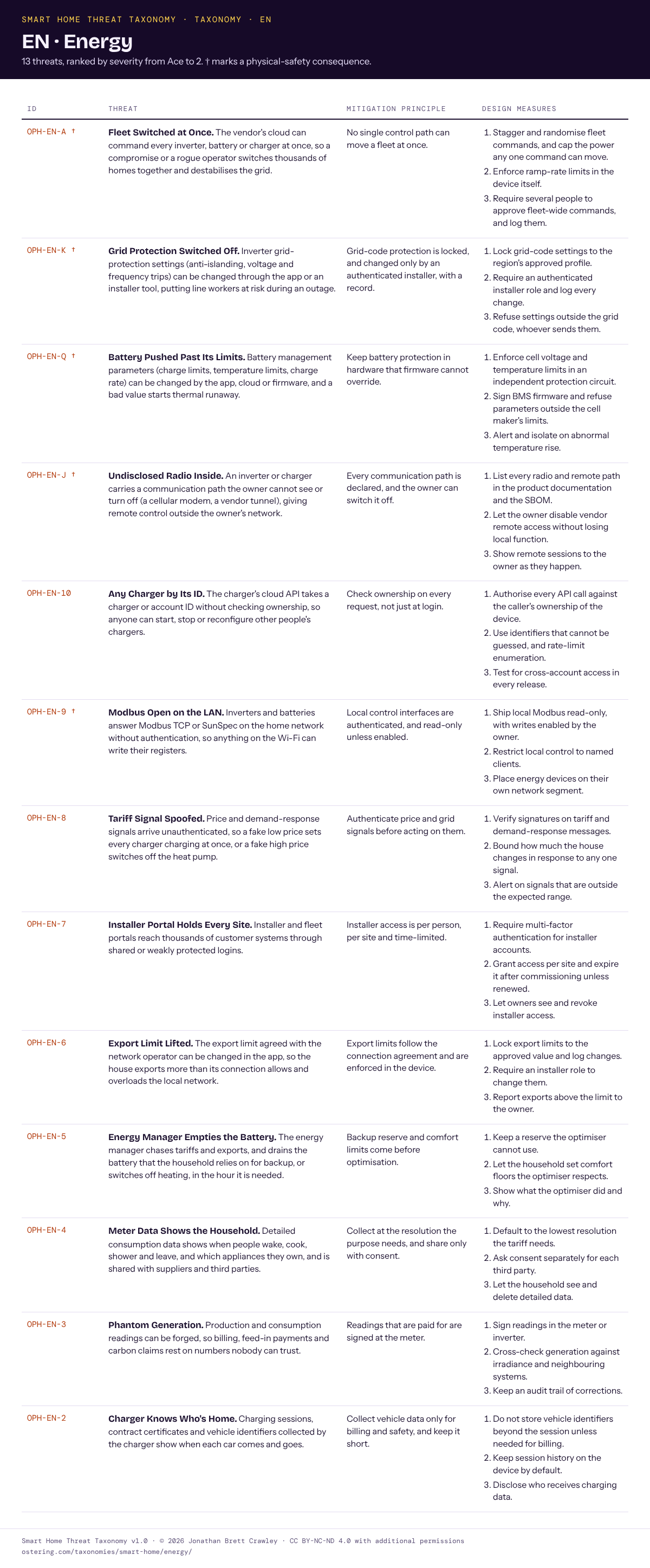
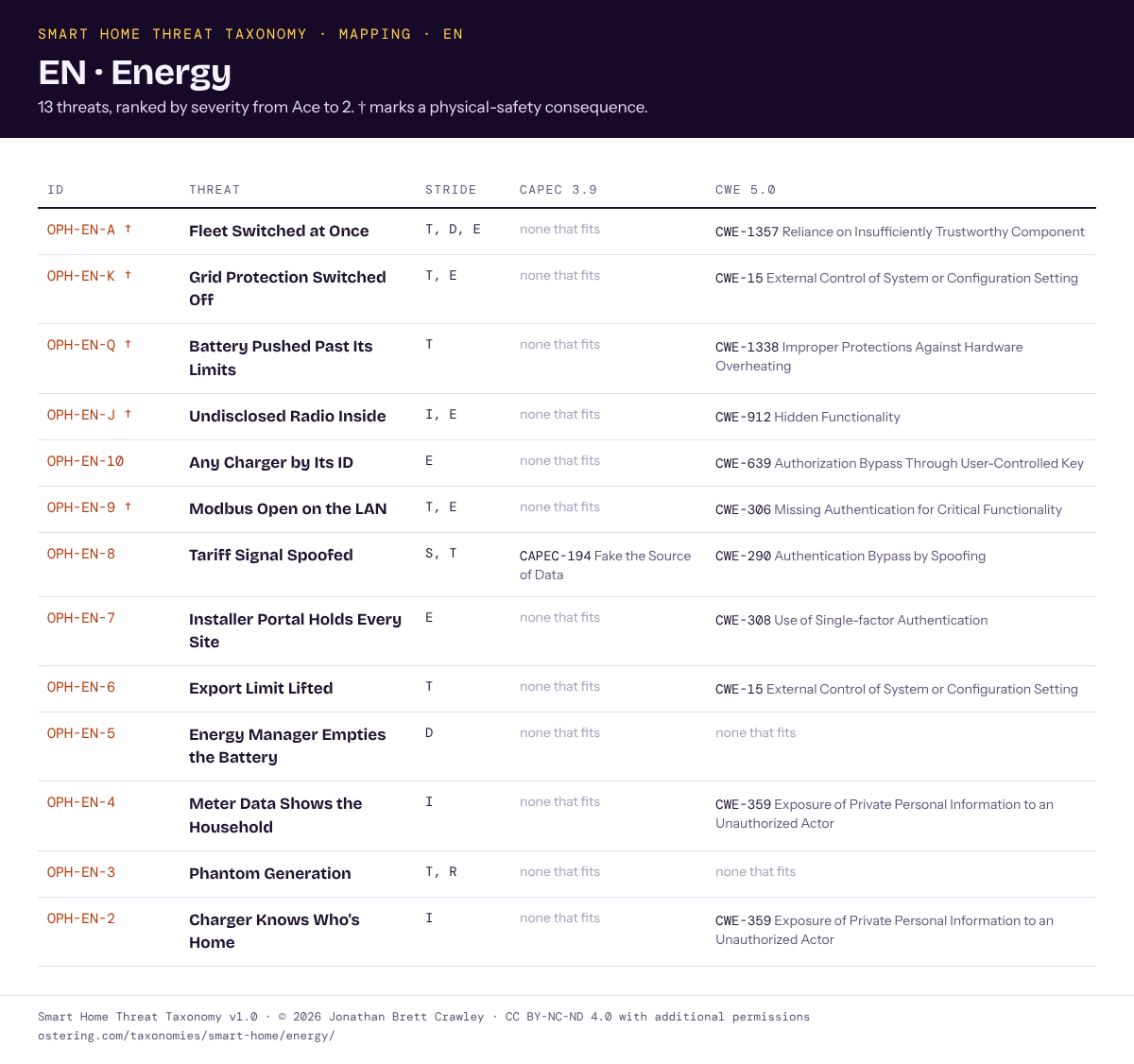
- OPH-EN-A † Fleet Switched at Once. The vendor’s cloud can command every inverter, battery or charger at once, so a compromise or a rogue operator switches thousands of homes together and destabilises the grid.
- OPH-EN-K † Grid Protection Switched Off. Inverter grid-protection settings (anti-islanding, voltage and frequency trips) can be changed through the app or an installer tool, putting line workers at risk during an outage.
- OPH-EN-Q † Battery Pushed Past Its Limits. Battery management parameters (charge limits, temperature limits, charge rate) can be changed by the app, cloud or firmware, and a bad value starts thermal runaway.
- OPH-EN-J † Undisclosed Radio Inside. An inverter or charger carries a communication path the owner cannot see or turn off (a cellular modem, a vendor tunnel), giving remote control outside the owner’s network.
- OPH-EN-10 Any Charger by Its ID. The charger’s cloud API takes a charger or account ID without checking ownership, so anyone can start, stop or reconfigure other people’s chargers.
- OPH-EN-9 † Modbus Open on the LAN. Inverters and batteries answer Modbus TCP or SunSpec on the home network without authentication, so anything on the Wi-Fi can write their registers.
- OPH-EN-8 Tariff Signal Spoofed. Price and demand-response signals arrive unauthenticated, so a fake low price sets every charger charging at once, or a fake high price switches off the heat pump.
- OPH-EN-7 Installer Portal Holds Every Site. Installer and fleet portals reach thousands of customer systems through shared or weakly protected logins.
- OPH-EN-6 Export Limit Lifted. The export limit agreed with the network operator can be changed in the app, so the house exports more than its connection allows and overloads the local network.
- OPH-EN-5 Energy Manager Empties the Battery. The energy manager chases tariffs and exports, and drains the battery that the household relies on for backup, or switches off heating, in the hour it is needed.
- OPH-EN-4 Meter Data Shows the Household. Detailed consumption data shows when people wake, cook, shower and leave, and which appliances they own, and is shared with suppliers and third parties.
- OPH-EN-3 Phantom Generation. Production and consumption readings can be forged, so billing, feed-in payments and carbon claims rest on numbers nobody can trust.
- OPH-EN-2 Charger Knows Who’s Home. Charging sessions, contract certificates and vehicle identifiers collected by the charger show when each car comes and goes.
† marks a physical-safety consequence. The full principle, measures and mappings for each entry are in the tables above and in the downloads.
Seen in the wild
- OPH-EN-A Fleet Switched at Once. MadIoT (Princeton, USENIX Security 2018); SUN:DOWN (Forescout, 2025). BlackIoT: IoT Botnet of High Wattage Devices Can Disrupt the Power Grid (USENIX Security 2018)
- OPH-EN-J Undisclosed Radio Inside. Undocumented communication devices reported in inverters (Reuters, May 2025). Hidden devices found in Chinese-made inverters in the US, reports Reuters (pv magazine, May 2025)
- OPH-EN-10 Any Charger by Its ID. Charger API flaws at Wallbox and Project EV (Pen Test Partners, 2021). Smart car chargers: plug n play for hackers? (Pen Test Partners, July 2021)
← Previous: Appliances · All suits · Next: Home Network →
Smart Home Threat Taxonomy v1.0 · © 2026 Jonathan Brett Crawley · Licensed under CC BY-NC-ND 4.0 with additional permissions.