Voice and Automations
Smart Home Threat Taxonomy › Voice and Automations (OPH-VA)
Voice assistants, routines and scenes, rules and scripts, third-party skills and AI agents: the layer that turns words and events into actions on the house without a person pressing a button.
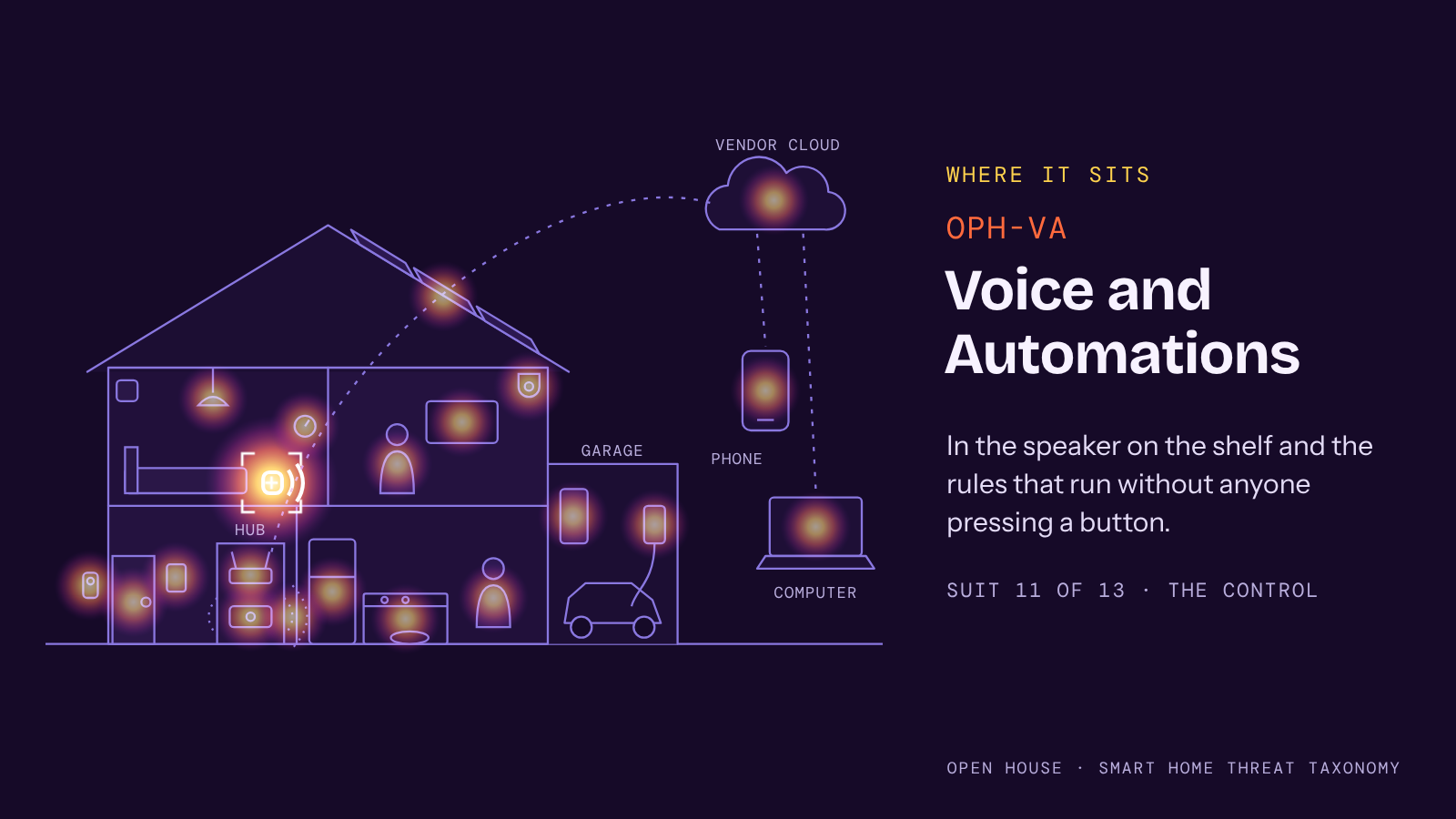
Where it sits in the house
The Voice and Automations suit sits in the speaker on the shelf and the rules that run without anyone pressing a button. It is suit 11 of 13, in the Control deck.
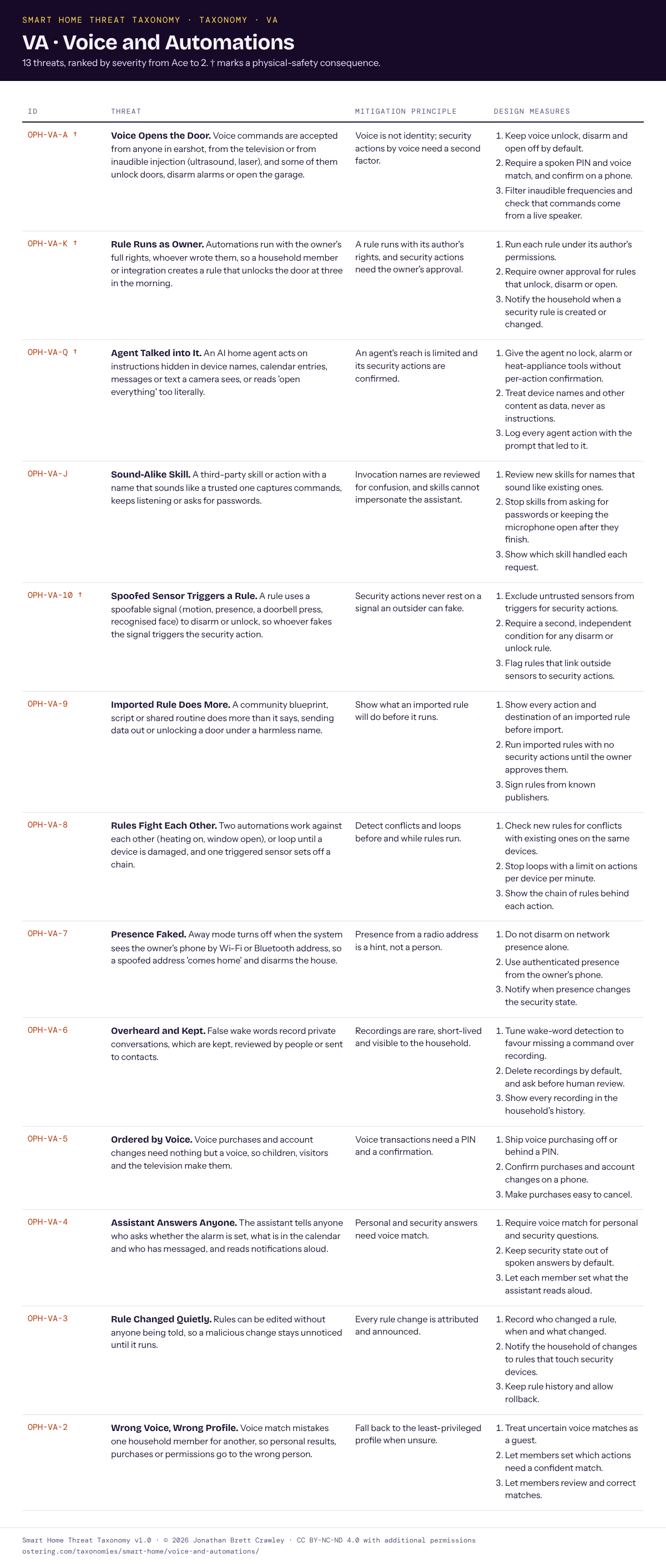
The table
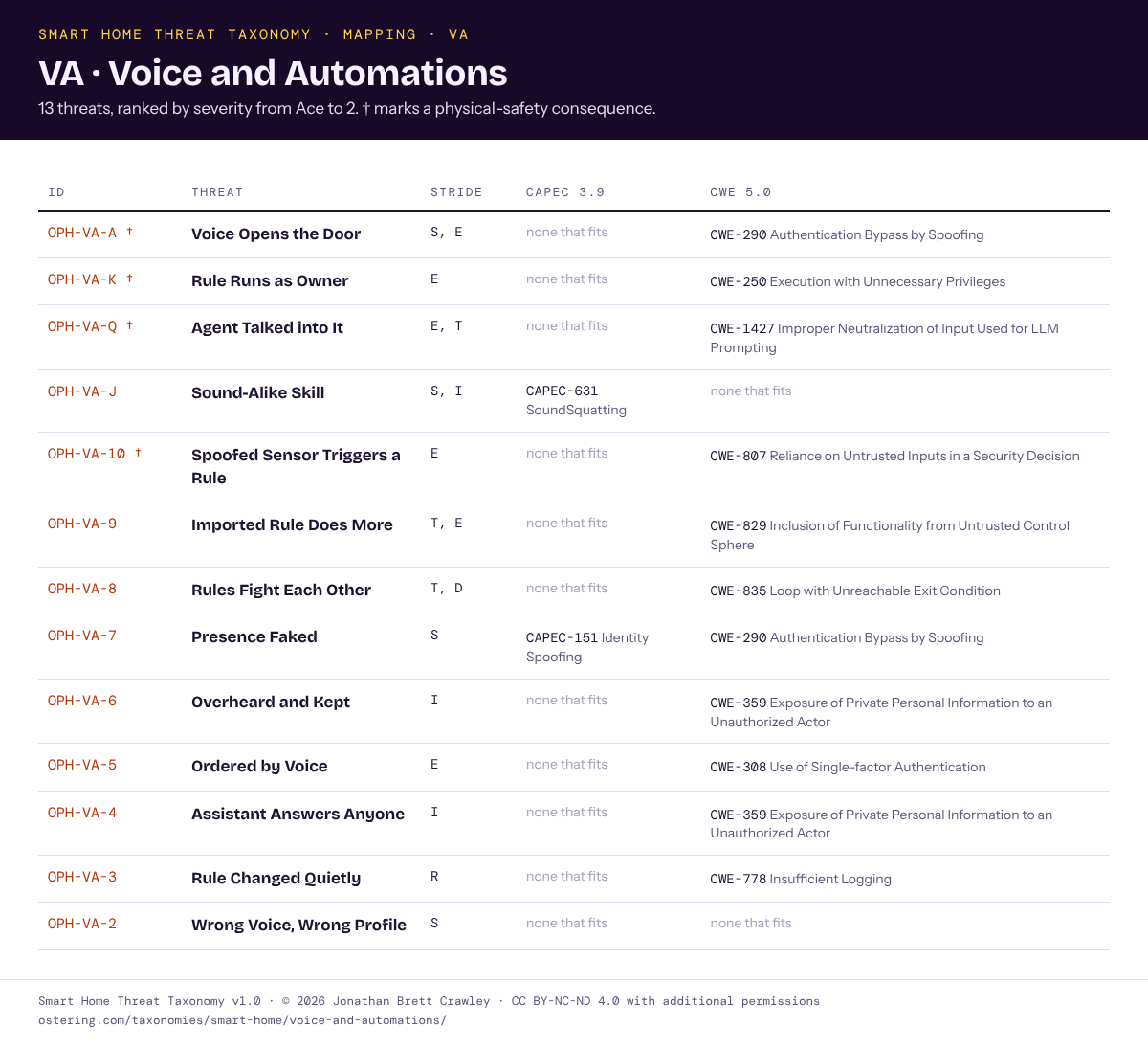
Mappings
Entries in text
- OPH-VA-A † Voice Opens the Door. Voice commands are accepted from anyone in earshot, from the television or from inaudible injection (ultrasound, laser), and some of them unlock doors, disarm alarms or open the garage.
- OPH-VA-K † Rule Runs as Owner. Automations run with the owner’s full rights, whoever wrote them, so a household member or integration creates a rule that unlocks the door at three in the morning.
- OPH-VA-Q † Agent Talked into It. An AI home agent acts on instructions hidden in device names, calendar entries, messages or text a camera sees, or reads ‘open everything’ too literally.
- OPH-VA-J Sound-Alike Skill. A third-party skill or action with a name that sounds like a trusted one captures commands, keeps listening or asks for passwords.
- OPH-VA-10 † Spoofed Sensor Triggers a Rule. A rule uses a spoofable signal (motion, presence, a doorbell press, recognised face) to disarm or unlock, so whoever fakes the signal triggers the security action.
- OPH-VA-9 Imported Rule Does More. A community blueprint, script or shared routine does more than it says, sending data out or unlocking a door under a harmless name.
- OPH-VA-8 Rules Fight Each Other. Two automations work against each other (heating on, window open), or loop until a device is damaged, and one triggered sensor sets off a chain.
- OPH-VA-7 Presence Faked. Away mode turns off when the system sees the owner’s phone by Wi-Fi or Bluetooth address, so a spoofed address ‘comes home’ and disarms the house.
- OPH-VA-6 Overheard and Kept. False wake words record private conversations, which are kept, reviewed by people or sent to contacts.
- OPH-VA-5 Ordered by Voice. Voice purchases and account changes need nothing but a voice, so children, visitors and the television make them.
- OPH-VA-4 Assistant Answers Anyone. The assistant tells anyone who asks whether the alarm is set, what is in the calendar and who has messaged, and reads notifications aloud.
- OPH-VA-3 Rule Changed Quietly. Rules can be edited without anyone being told, so a malicious change stays unnoticed until it runs.
- OPH-VA-2 Wrong Voice, Wrong Profile. Voice match mistakes one household member for another, so personal results, purchases or permissions go to the wrong person.
† marks a physical-safety consequence. The full principle, measures and mappings for each entry are in the tables above and in the downloads.
Seen in the wild
- OPH-VA-A Voice Opens the Door. DolphinAttack (2017); Light Commands (2019). DolphinAttack: Inaudible Voice Commands (Zhang et al., ACM CCS 2017)
- OPH-VA-J Sound-Alike Skill. Skill Squatting (Kumar et al., USENIX Security 2018); Smart Spies (SRLabs, 2019). Smart Spies: Alexa and Google Home expose users to vishing and eavesdropping (SRLabs, Oct 2019)
- OPH-VA-6 Overheard and Kept. Alexa recording sent to a contact (Portland, 2018). This family’s Echo sent a private conversation to a random contact (TechCrunch, May 2018)
- OPH-VA-5 Ordered by Voice. Alexa dollhouse order by a child (Dallas, Jan 2017). Amazon Alexa dollhouse order story (CNN, 5 Jan 2017)
← Previous: Remote Control · All suits · Next: Household →
Smart Home Threat Taxonomy v1.0 · © 2026 Jonathan Brett Crawley · Licensed under CC BY-NC-ND 4.0 with additional permissions.