Domotics
Smart Home Threat Taxonomy › Domotics (OPH-DM)
Lighting, heating and cooling, blinds, plugs and relays, water valves and leak sensors: the building services that the house runs on. A bad command here is a physical event: heat, cold, water or darkness.
Where it sits in the house
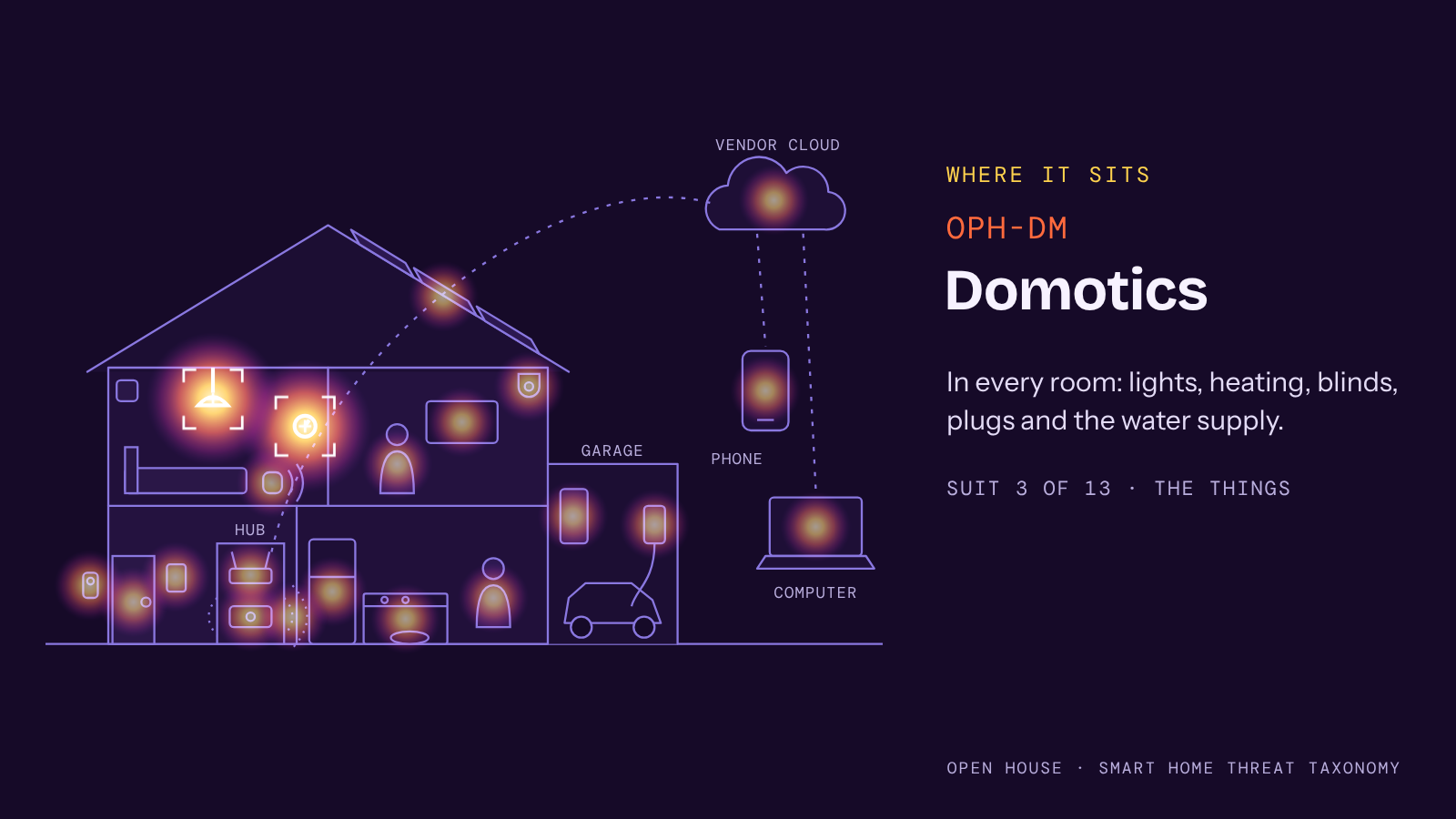
The Domotics suit sits in every room: lights, heating, blinds, plugs and the water supply. It is suit 3 of 13, in the Things deck.
The table
Mappings
Entries in text
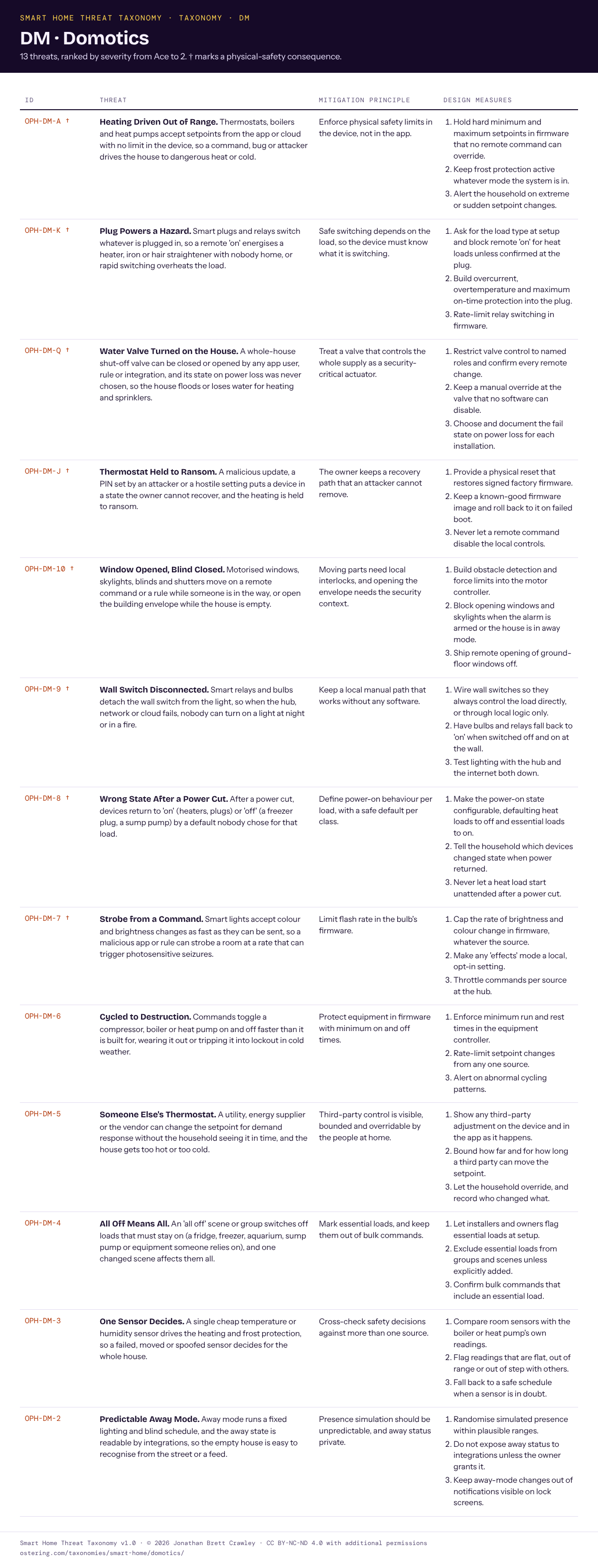
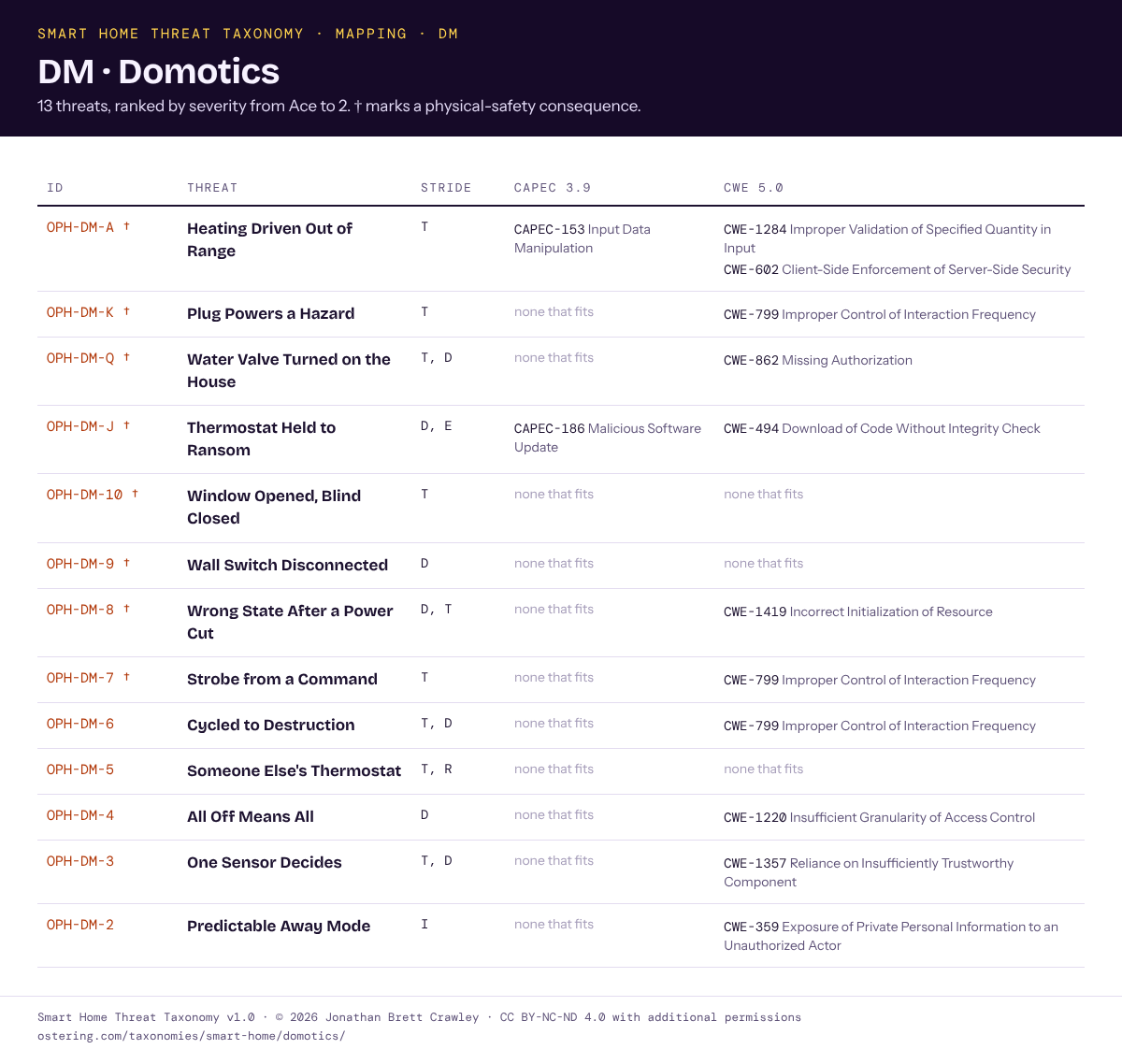
- OPH-DM-A † Heating Driven Out of Range. Thermostats, boilers and heat pumps accept setpoints from the app or cloud with no limit in the device, so a command, bug or attacker drives the house to dangerous heat or cold.
- OPH-DM-K † Plug Powers a Hazard. Smart plugs and relays switch whatever is plugged in, so a remote ‘on’ energises a heater, iron or hair straightener with nobody home, or rapid switching overheats the load.
- OPH-DM-Q † Water Valve Turned on the House. A whole-house shut-off valve can be closed or opened by any app user, rule or integration, and its state on power loss was never chosen, so the house floods or loses water for heating and sprinklers.
- OPH-DM-J † Thermostat Held to Ransom. A malicious update, a PIN set by an attacker or a hostile setting puts a device in a state the owner cannot recover, and the heating is held to ransom.
- OPH-DM-10 † Window Opened, Blind Closed. Motorised windows, skylights, blinds and shutters move on a remote command or a rule while someone is in the way, or open the building envelope while the house is empty.
- OPH-DM-9 † Wall Switch Disconnected. Smart relays and bulbs detach the wall switch from the light, so when the hub, network or cloud fails, nobody can turn on a light at night or in a fire.
- OPH-DM-8 † Wrong State After a Power Cut. After a power cut, devices return to ‘on’ (heaters, plugs) or ‘off’ (a freezer plug, a sump pump) by a default nobody chose for that load.
- OPH-DM-7 † Strobe from a Command. Smart lights accept colour and brightness changes as fast as they can be sent, so a malicious app or rule can strobe a room at a rate that can trigger photosensitive seizures.
- OPH-DM-6 Cycled to Destruction. Commands toggle a compressor, boiler or heat pump on and off faster than it is built for, wearing it out or tripping it into lockout in cold weather.
- OPH-DM-5 Someone Else’s Thermostat. A utility, energy supplier or the vendor can change the setpoint for demand response without the household seeing it in time, and the house gets too hot or too cold.
- OPH-DM-4 All Off Means All. An ‘all off’ scene or group switches off loads that must stay on (a fridge, freezer, aquarium, sump pump or equipment someone relies on), and one changed scene affects them all.
- OPH-DM-3 One Sensor Decides. A single cheap temperature or humidity sensor drives the heating and frost protection, so a failed, moved or spoofed sensor decides for the whole house.
- OPH-DM-2 Predictable Away Mode. Away mode runs a fixed lighting and blind schedule, and the away state is readable by integrations, so the empty house is easy to recognise from the street or a feed.
† marks a physical-safety consequence. The full principle, measures and mappings for each entry are in the tables above and in the downloads.
Seen in the wild
- OPH-DM-J Thermostat Held to Ransom. Thermostat ransomware demonstration (Pen Test Partners, DEF CON 24, 2016). Thermostat ransomware: a lesson in IoT security (Pen Test Partners)
- OPH-DM-5 Someone Else’s Thermostat. Texas heat wave demand-response thermostat adjustments (June 2021). Why your smart thermostat may raise the temperature inside your house in Texas heat waves (Dallas Morning News, June 2021)
← Previous: Radio and Mesh · All suits · Next: Cameras and Doorbells →
Smart Home Threat Taxonomy v1.0 · © 2026 Jonathan Brett Crawley · Licensed under CC BY-NC-ND 4.0 with additional permissions.