Interpretation (IN)
Taxonomies › Care assistant › Interpretation
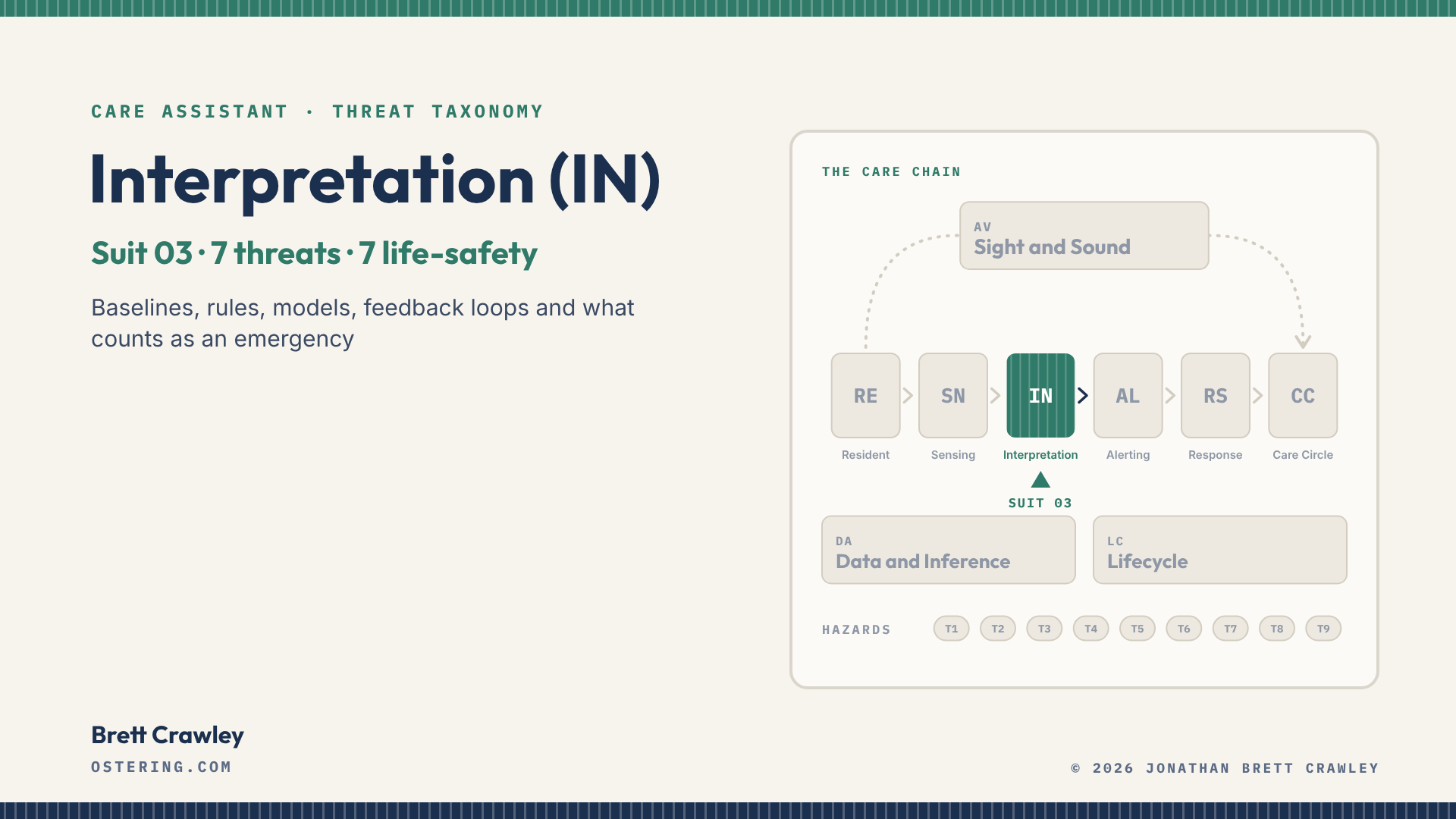
Suit 03 of 9 · 7 threats, 7 of them life-safety · prefix IN
Interpretation threats change what counts as an emergency, through drift, feedback, inference or an unauthorised change to the rules.
Scope: Baselines, rules, models, feedback loops and what counts as an emergency.
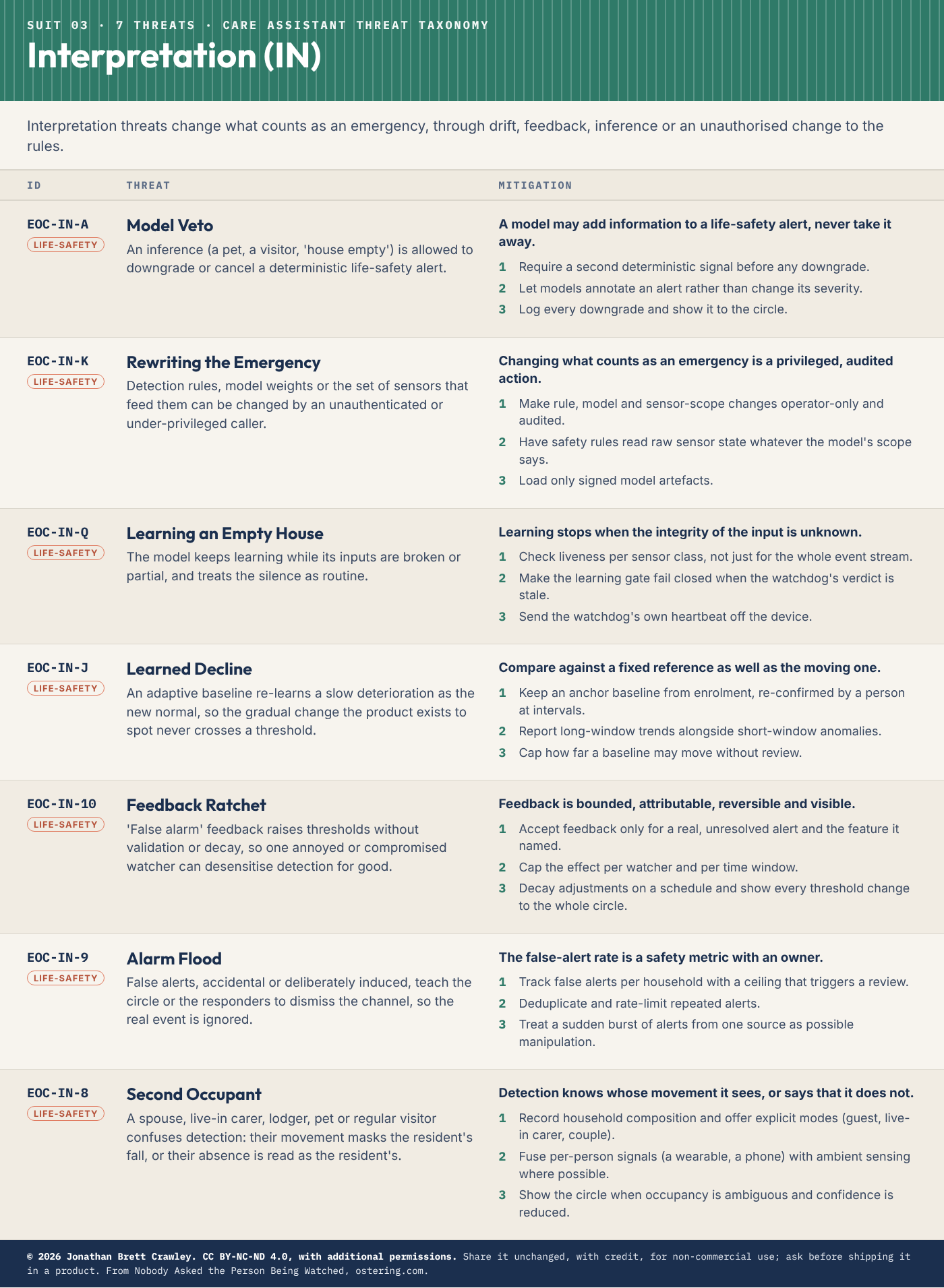
Text version: every entry on this page is in the PDF and Excel downloads on the overview page, where it can be searched and copied.
The threats
- EOC-IN-A Model Veto †
- EOC-IN-K Rewriting the Emergency †
- EOC-IN-Q Learning an Empty House †
- EOC-IN-J Learned Decline †
- EOC-IN-10 Feedback Ratchet †
- EOC-IN-9 Alarm Flood †
- EOC-IN-8 Second Occupant †
† marks a life-safety entry: one whose failure can leave someone without help when they need it.
Where this suit touches others
- Sensing and Interpretation: sensing decides what the system hears; interpretation decides what it makes of it, including what it makes of silence.
- Interpretation and Alerting: interpretation decides that something is an emergency; alerting decides whether a person ever finds out.
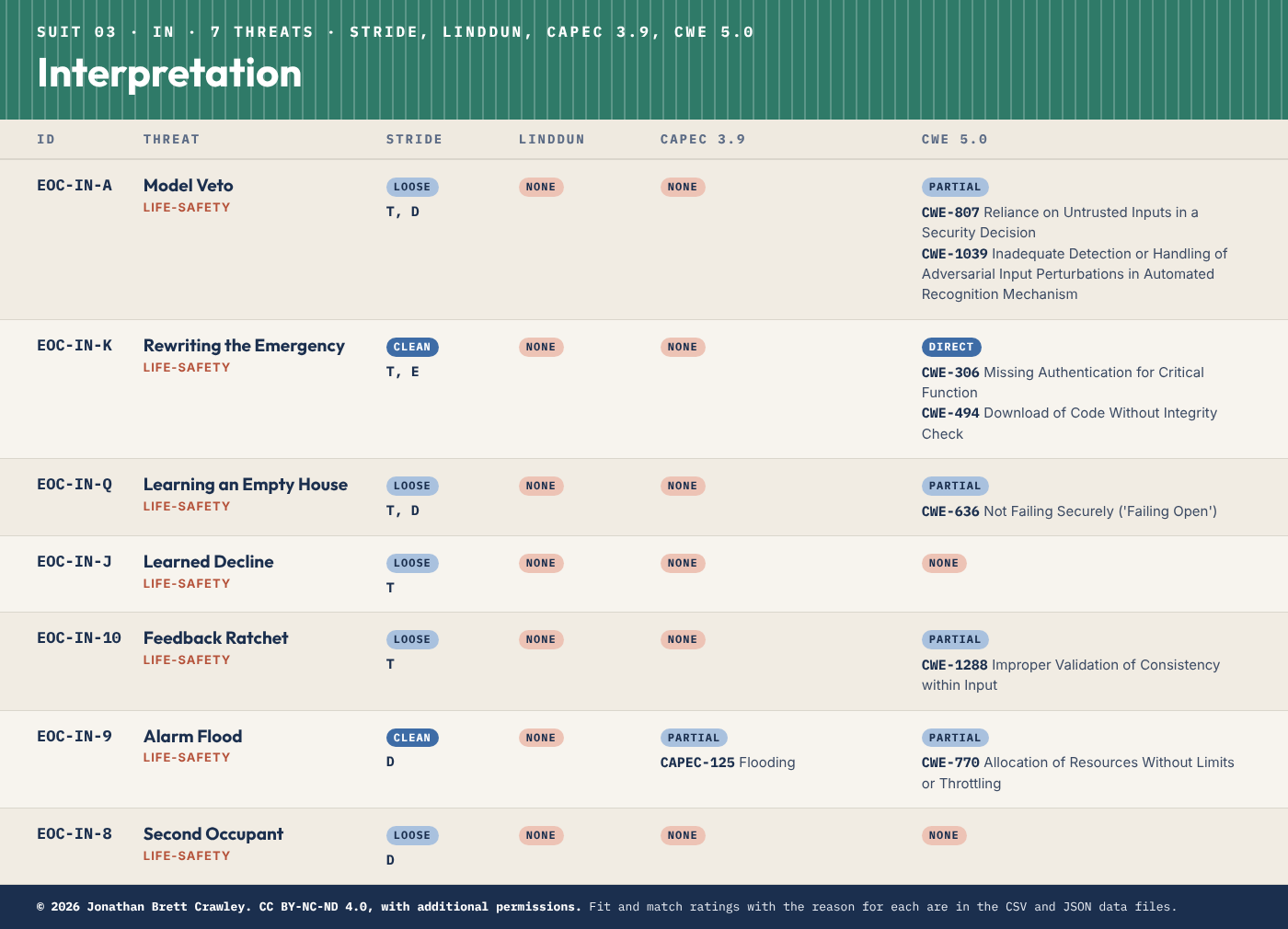
STRIDE, LINDDUN, CAPEC and CWE
Of the 7 entries here, STRIDE fits 2 cleanly and 5 only loosely. LINDDUN fits none of them. CAPEC 3.9 has only a generic parent pattern for 1 and has nothing for 6. CWE 5.0 names the weakness directly for 1, has only a broader weakness for 4 and has nothing for 2. All four frameworks miss 5 of them: no clean STRIDE or LINDDUN prompt, and no direct CAPEC or CWE match. The table below gives the mapping entry by entry, with the names of the CAPEC patterns and CWE weaknesses; what the mapping shows across the whole taxonomy is in Mapping the Care Assistant Threat Taxonomy to STRIDE, LINDDUN, CAPEC and CWE. The Excel, SKOS and STIX downloads carry the same mapping as text.
← Sight and Sound (AV) · Care assistant overview · Alerting (AL) →
© 2026 Jonathan Brett Crawley. Licensed under CC BY-NC-ND 4.0 with additional permissions: see the licence on the care assistant overview.