The Rehearsal Is Free: Reading Europe's Hybrid Attacks Through the Black Start Taxonomy

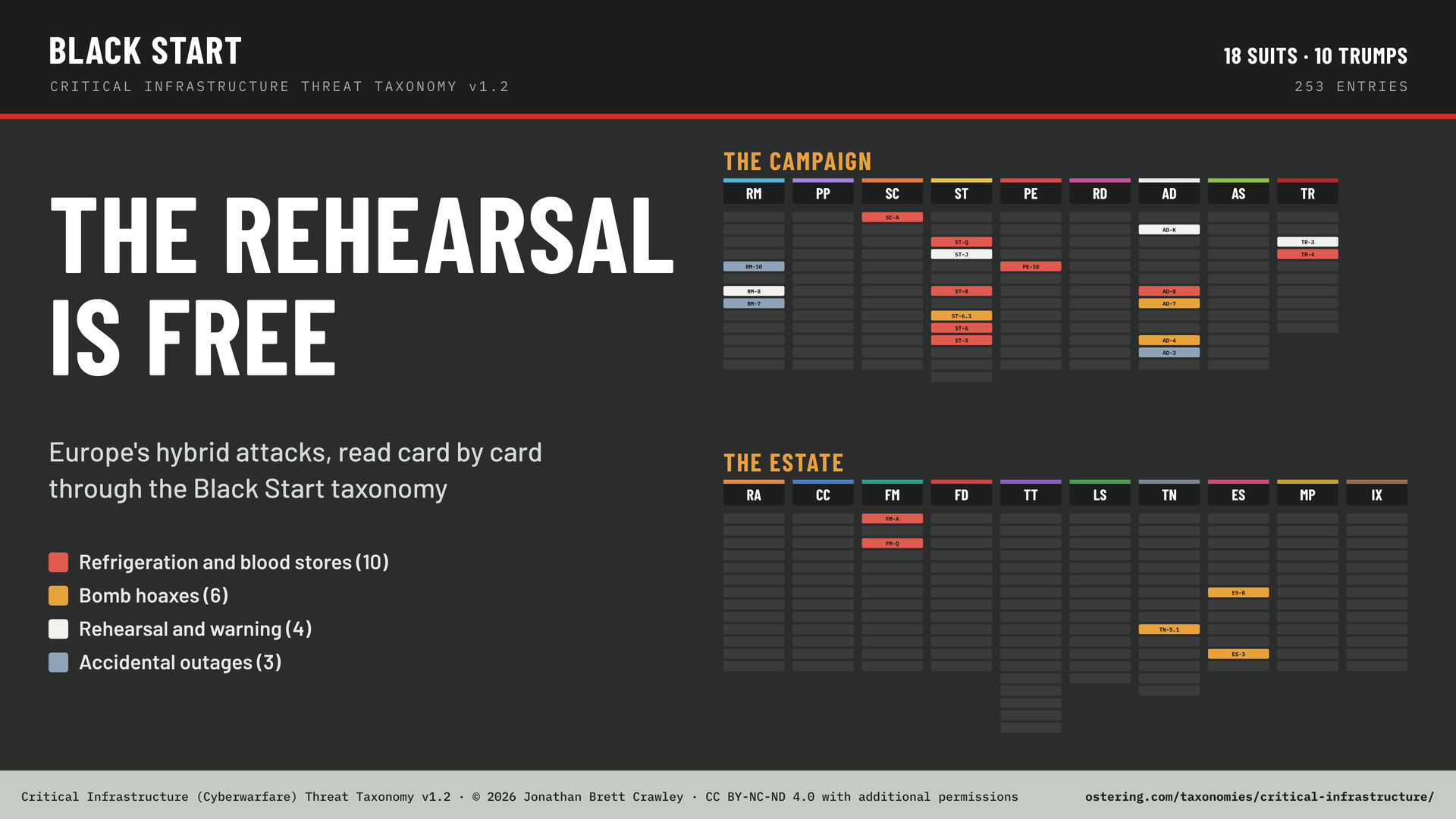
The Rehearsal Is Free: Reading Europe’s Hybrid Attacks Through the Black Start Taxonomy
TL;DR
- Since mid-October, attackers have remotely warmed supermarket fridges in at least ten European countries and tried to push stores of transfusion plasma in France towards 110 °C. Hoaxers have sent bomb threats to dozens of flights, three broadcasters and around 6,300 Italian schools.
- No blood was lost and no bombs were found. That’s less reassuring than it sounds: each wave measured how fast operators notice, who decides, when governments escalate and how long attribution takes.
- My Black Start critical infrastructure threat taxonomy has cards for exactly this pattern: limited strikes that rehearse the mechanism and measure the response. Twenty-three of its 253 entries lit up this month.
- Every entry carries a mitigation principle and numbered design measures. The recommendations in this post come straight from them.
- Two of the cards (hoax waves and threat assessment at scale) were added in v1.1 on 8 November, while the hoax wave was still unfolding. Version 1.2, published on 14 November, adds an Emergency and Broadcast suit with two more.
- On the evidence so far this is harassment, not an attempt at breakdown. The thing to watch for is an attack on power, water or payments that lasts more than a day.
In my previous post I walked last week’s Microsoft outage through my email threat taxonomy. This one is about something bigger, and to me more worrying, that sits around it.
Over the past five weeks, Europe has had freezers hijacked, a blood service targeted and a run of bomb hoaxes. Each incident has been reported as its own story, and each has ended with reassurance: no damage, no health impact, no concrete danger. I think that framing misses the point. Put the incidents side by side on the Black Start map, and they stop looking like separate stories.
The Taxonomy in Two Minutes
Black Start is built as two decks of cards plus a set of Trumps:
- The Campaign describes what an adversary does: reconnaissance and mapping, pre-positioning, the service chain, scale and timing, process effects, recovery denial, aftermath and deniability, and air and spectrum.
- The Estate describes what’s being defended: remote and vendor access, control centres, fleet management platforms, field devices, telecoms, logistics, transport, emergency services and broadcasters, money and payments, and the interdependencies between them.
- The Trumps are ten structural hazards that cut across everything, such as Every feature is dual-use and The adversary has time.
Each entry has a reference (BKS-ST-J, BKS-PE-10), a threat, a real case where there is one, a mitigation principle, numbered design measures, and mappings to STRIDE, CAPEC, CWE, MITRE ATT&CK for ICS and the Cyber-Informed Engineering (CIE) principles. A † marks entries with a physical-safety consequence.
Ranks are frozen once published, so references stay stable in your risk register. When a new threat belongs between two existing cards, it gets an intermediate rank: that’s why you’ll see BKS-ST-6.1 and BKS-TN-5.1 below.
Here’s where October and November landed:
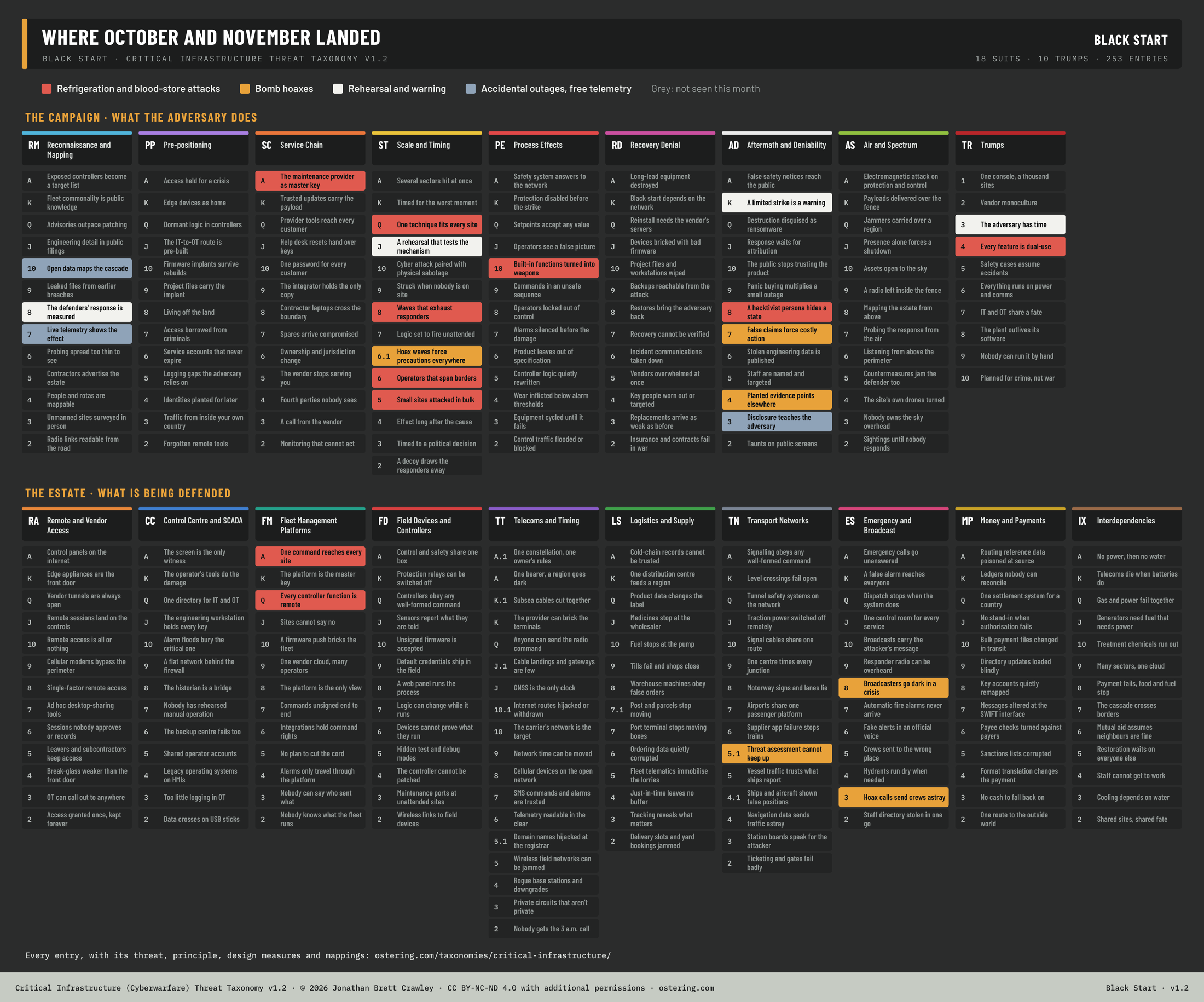
Red: refrigeration and blood-store attacks. Amber: bomb hoaxes. White: rehearsal and warning. Blue: accidental outages that published useful data anyway.
Notice that most of the highlights sit in the Campaign deck. Very little of the Estate was damaged. What was exercised was the adversary’s toolkit: scale, timing, process effects and deniability.
What Has Happened
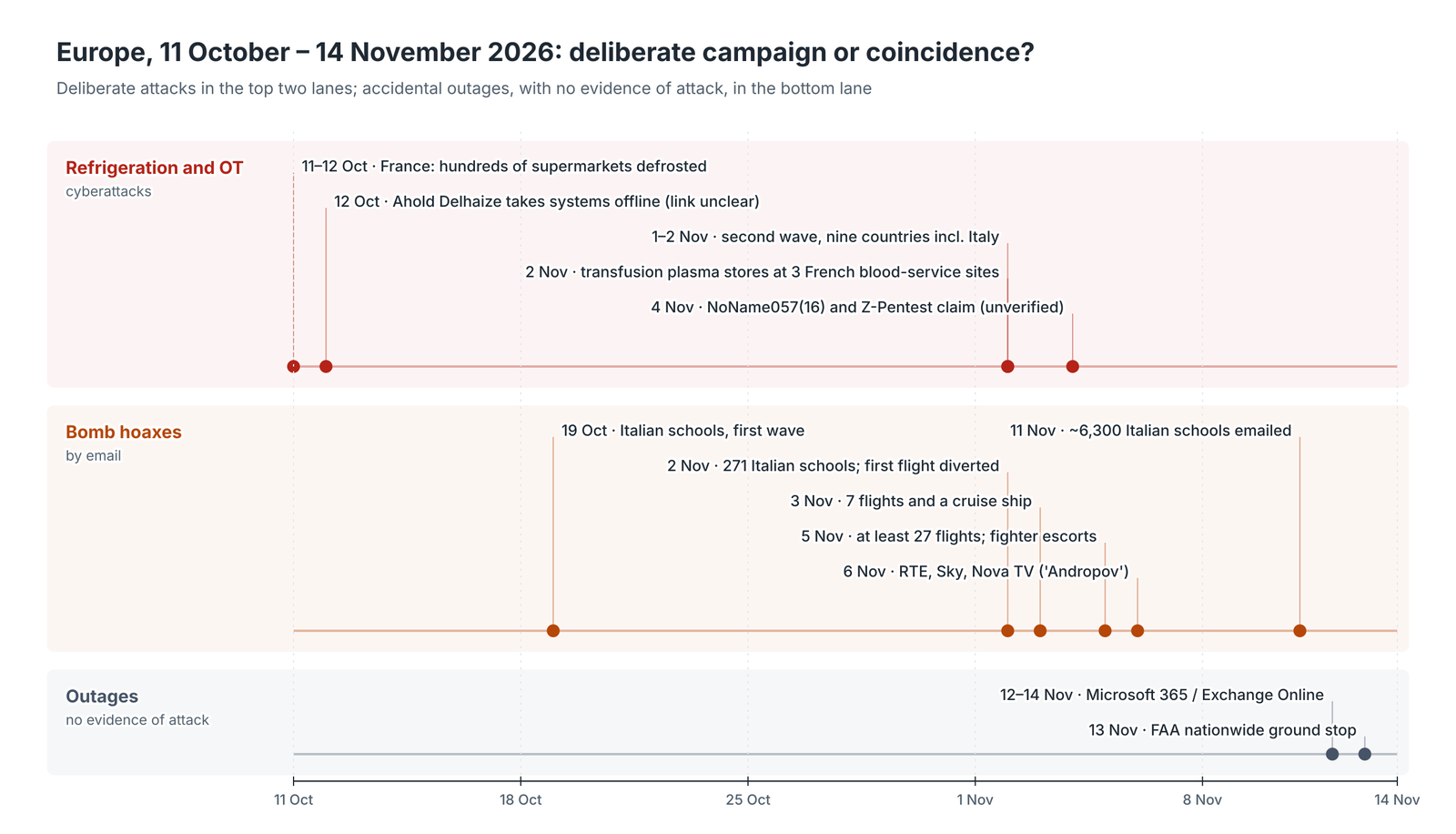
Deliberate attacks in the top two lanes; accidental outages, with no evidence of attack, in the bottom lane.
Refrigeration. On the night of 11 to 12 October, attackers used the built-in defrost function on older Danfoss controllers to warm the fridges of French supermarkets (BleepingComputer). A second wave on 1 and 2 November hit Belgium, Estonia, Finland, Ireland, Italy, Luxembourg, the Netherlands, Portugal and Sweden (Infosecurity Magazine). Danfoss said the Dutch systems it looked at had default passwords and no protected network (Xenospectrum).
Blood for transfusion. The same night, an attack on a refrigeration supplier changed temperature and defrost settings at three sites of France’s national blood service (EFS). Le Canard Enchaîné reported an attempt to move the set points from −30 °C to as high as 110 °C (AP via KPTV). An on-call technician noticed the temperatures rising before any blood products were affected (GovInfoSecurity).
Bomb hoaxes. From 2 November, hoax threats diverted flights across Europe; at least 27 were hit on 5 November alone, some with fighter escorts (Khaleej Times/Reuters). On 6 November RTE, Sky and Nova TV received threats signed “Mikhail Andropov” (Meduza/Reuters). On 11 November about 6,300 Italian state schools received the same threat, and Palazzo Chigi convened the intelligence services, ACN and two ministers (ItaliaOggi).
Who is behind it? Nobody has proved it. NoName057(16) and Z-Pentest claimed the refrigeration attacks, but SOCRadar rates the claim low to moderate confidence (SOCRadar). Denmark’s intelligence service has assessed that Z-Pentest has connections to the Russian state (Security Affairs). For the hoaxes, Kremlin involvement hasn’t been confirmed (Atlantic Council).
The Feature Was the Weapon: BKS-PE-10
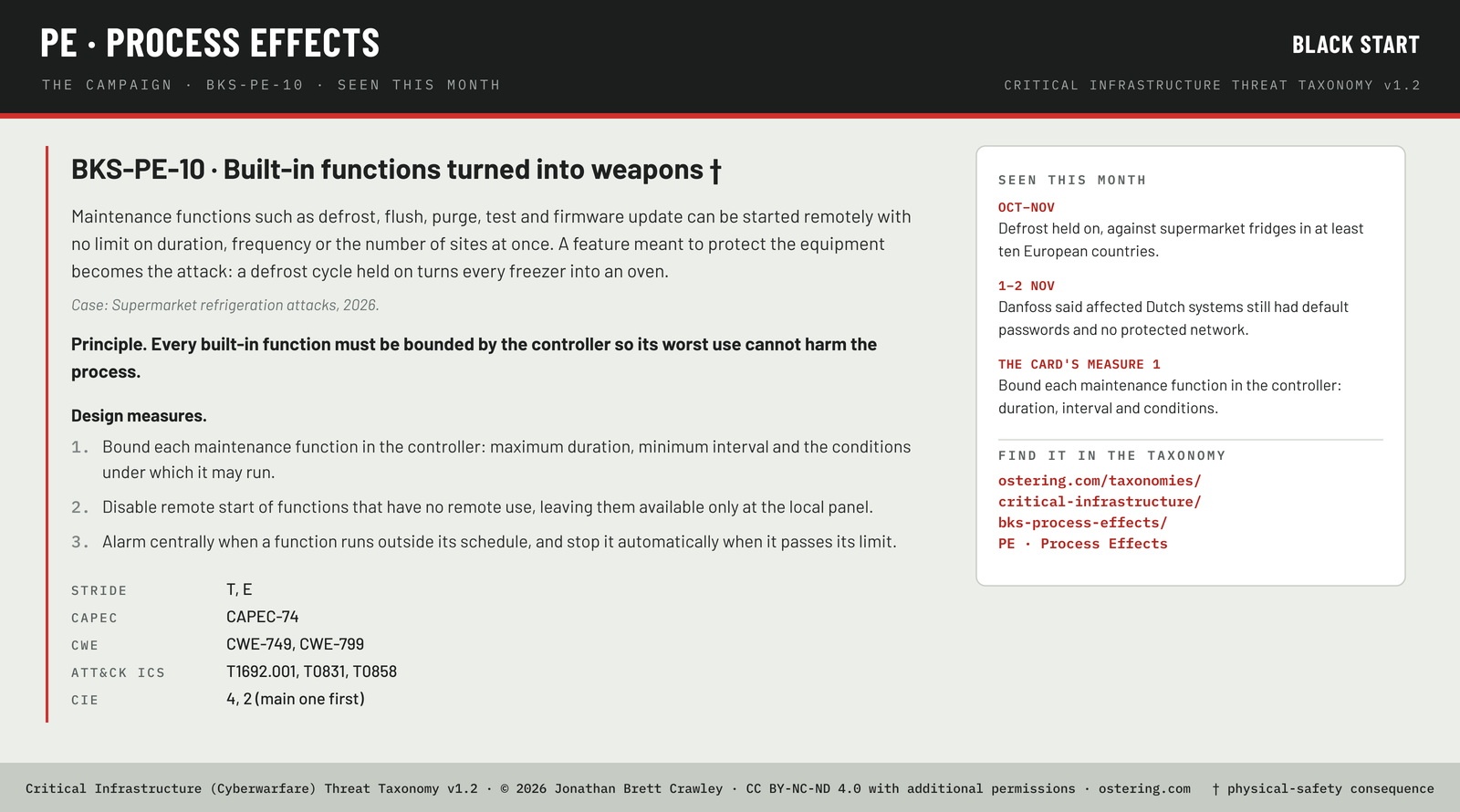
Nobody needed to write malware to warm a freezer. Defrost is a maintenance function, and it had no limit on how long it could run or how many sites could run it at once. BKS-PE-10 Built-in functions turned into weapons describes it exactly, and carries a † because the same mechanism in a blood store or a pharmacy is a patient-safety problem.
The card’s first design measure is the fix that matters most: bound each maintenance function in the controller: maximum duration, minimum interval and the conditions under which it may run. That moves the protection into the controller itself, where a stolen password can’t override it. It’s also BKS-TR-4 Every feature is dual-use in action, and BKS-ST-Q One technique fits every site: same technique, two nights, ten countries.
When the Fridge Holds Blood: CRI-FB-J.1
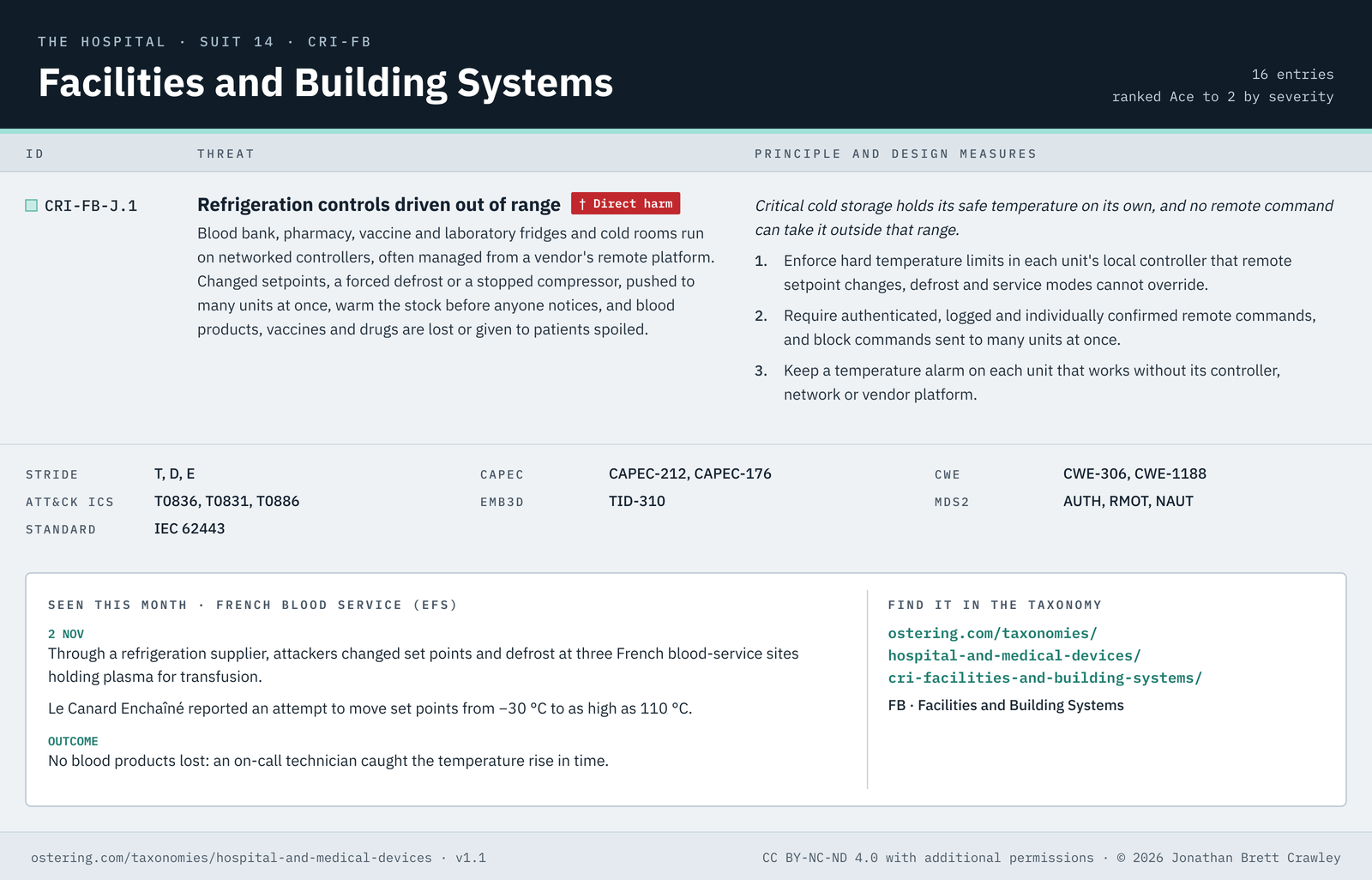
The EFS attack sits in my hospital and medical device taxonomy as CRI-FB-J.1 Refrigeration controls driven out of range, flagged as direct harm. Its principle is the one I’d put on the wall of every cold-chain operator: critical cold storage holds its safe temperature on its own, and no remote command can take it outside that range.
Measure 3 is the one that saved the day in France: keep a temperature alarm on each unit that works without its controller, network or vendor platform. The EFS had a separate alarm and a human on call. Many supermarkets found out when they opened.
Why “No Damage” Isn’t the End of the Story
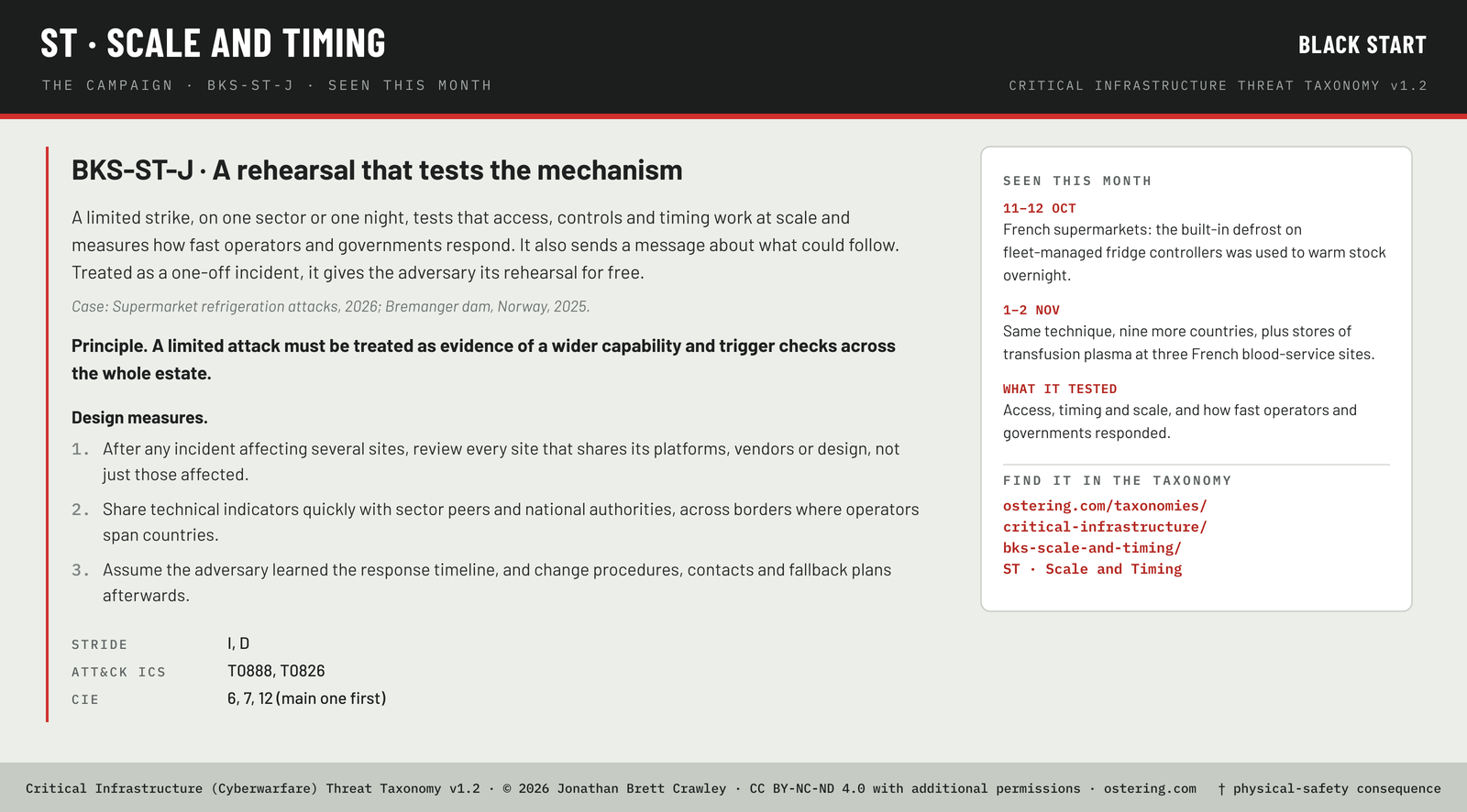
At first glance, an attack that destroys some food stock and a hoax that delays a flight are nuisances. But a state-backed adversary isn’t trying to make money from one victim. It wants many sites to fail at once, at a moment it chooses, and before that it needs to know whether its mechanism works and how you’ll react.
BKS-ST-J A rehearsal that tests the mechanism says it in one line: treated as a one-off incident, a limited strike gives the adversary its rehearsal for free. Its third measure is the uncomfortable one: assume the adversary learned the response timeline, and change procedures, contacts and fallback plans afterwards.
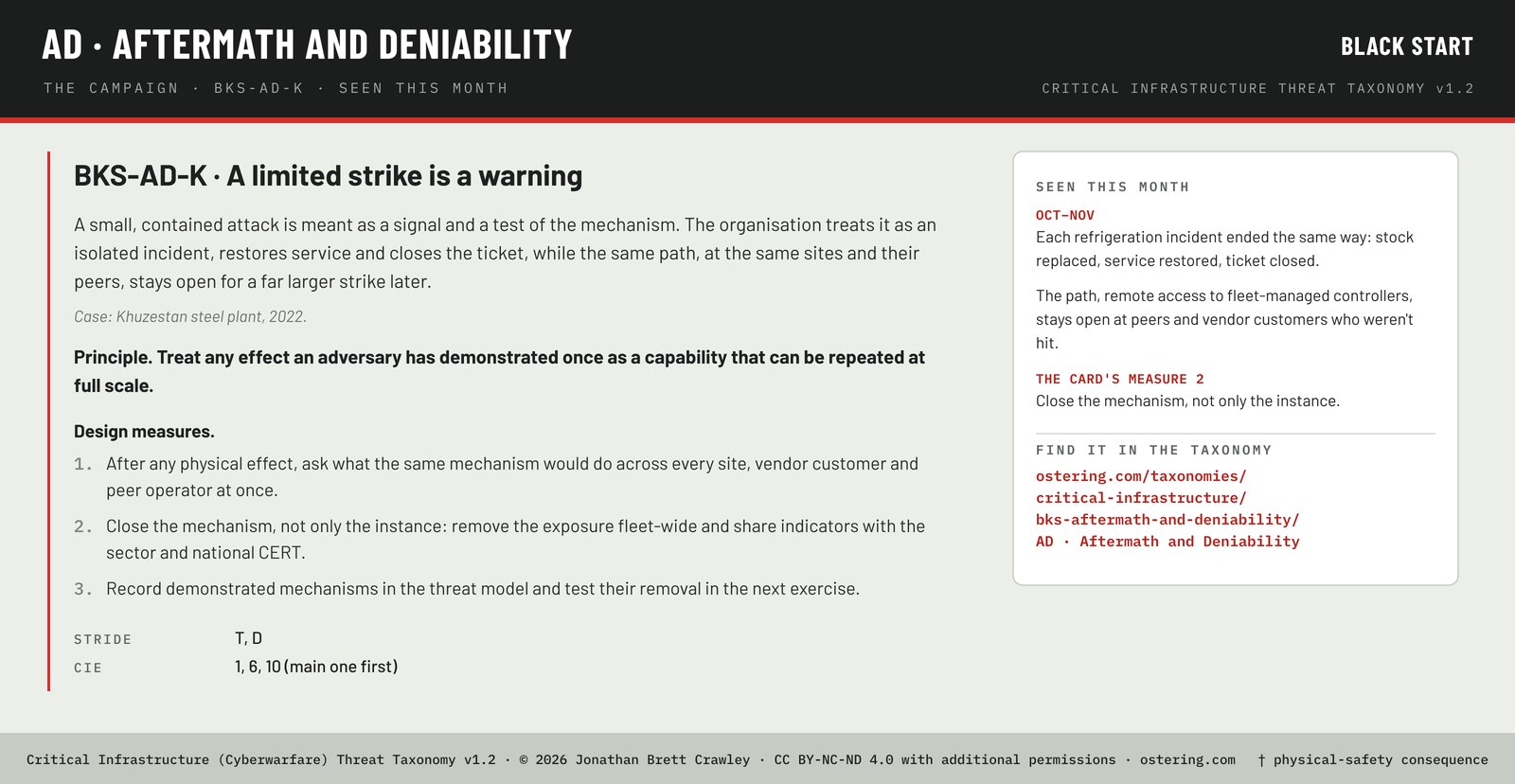
Its partner card, BKS-AD-K A limited strike is a warning, describes what happened after almost every incident this month: stock replaced, service restored, ticket closed, while the same path stays open at peers and at the vendor’s other customers. Measure 2 is short enough to memorise: close the mechanism, not only the instance.
What Each Wave Measured: BKS-RM-8
This is the part I’d like defenders to sit with. Here’s what an observer could learn from the past five weeks without spending much at all:
| What was measured | What we showed them |
|---|---|
| Overnight detection | At the blood service, a human on call plus a separate alarm caught it. Many supermarkets found out when they opened. |
| Who decides | 6,300 headteachers each decided alone whether to evacuate. |
| Escalation | A hoax email can scramble fighter jets and convene a meeting at the prime minister’s office. |
| Hygiene | Some controllers were still on default passwords and reachable without a protected network. |
| Attribution latency | Three personas in two weeks, deleted claims, and no confirmed attribution after a month. |
| Recovery | How quickly stores restocked, airlines recovered and broadcasters came back on air. |
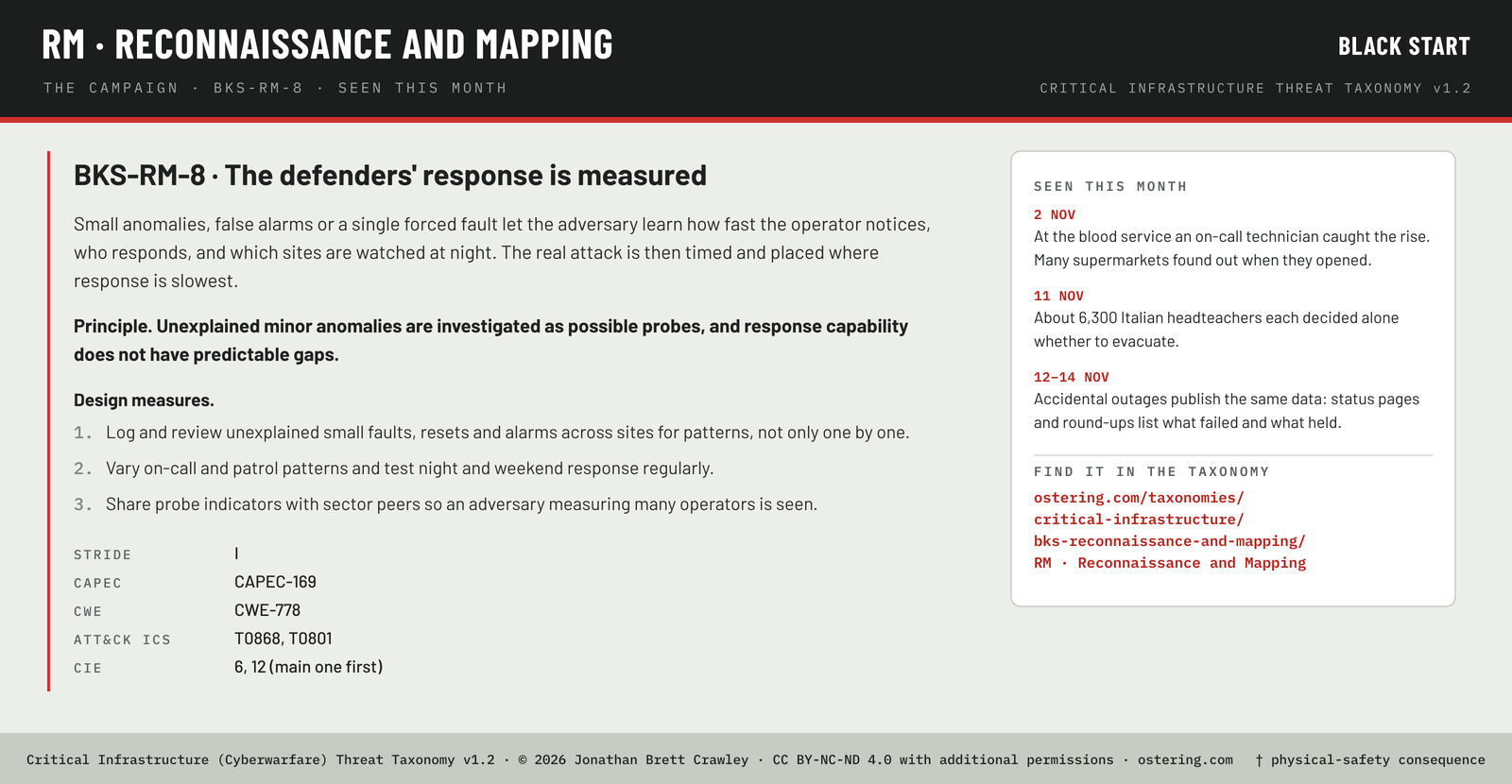
That’s BKS-RM-8 The defenders’ response is measured. Its measures are cheap and unglamorous: review small faults across sites for patterns, vary on-call patterns and test night and weekend response, and share probe indicators so an adversary measuring many operators is seen.
The Hoaxes: Two Cards Added Mid-Wave
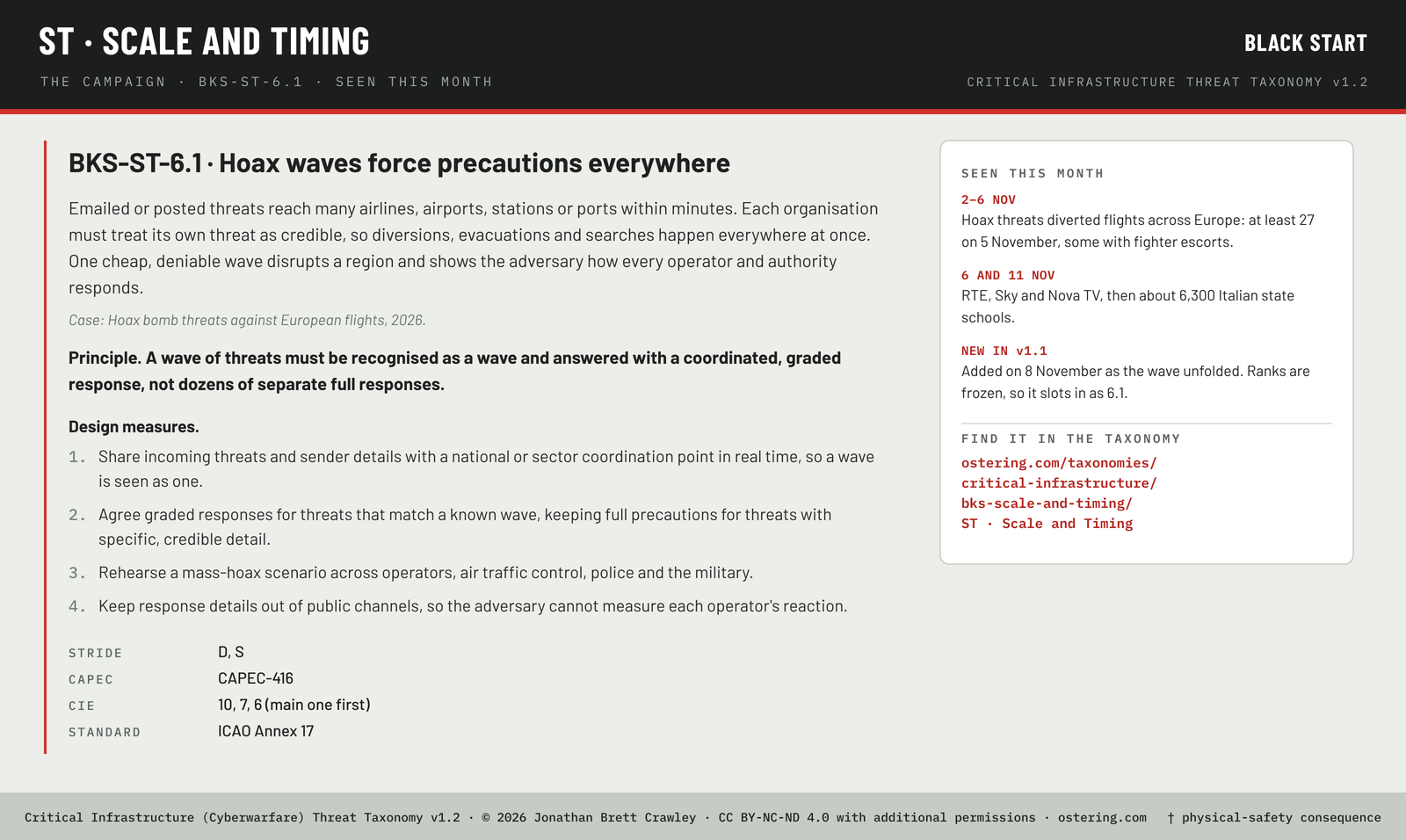
I added BKS-ST-6.1 Hoax waves force precautions everywhere on 8 November, with the hoax wave still running. The principle is that a wave of threats must be recognised as a wave and answered with a coordinated, graded response, not dozens of separate full responses. The fourth measure matters as much as the first: keep response details out of public channels, so the adversary can’t measure each operator’s reaction.
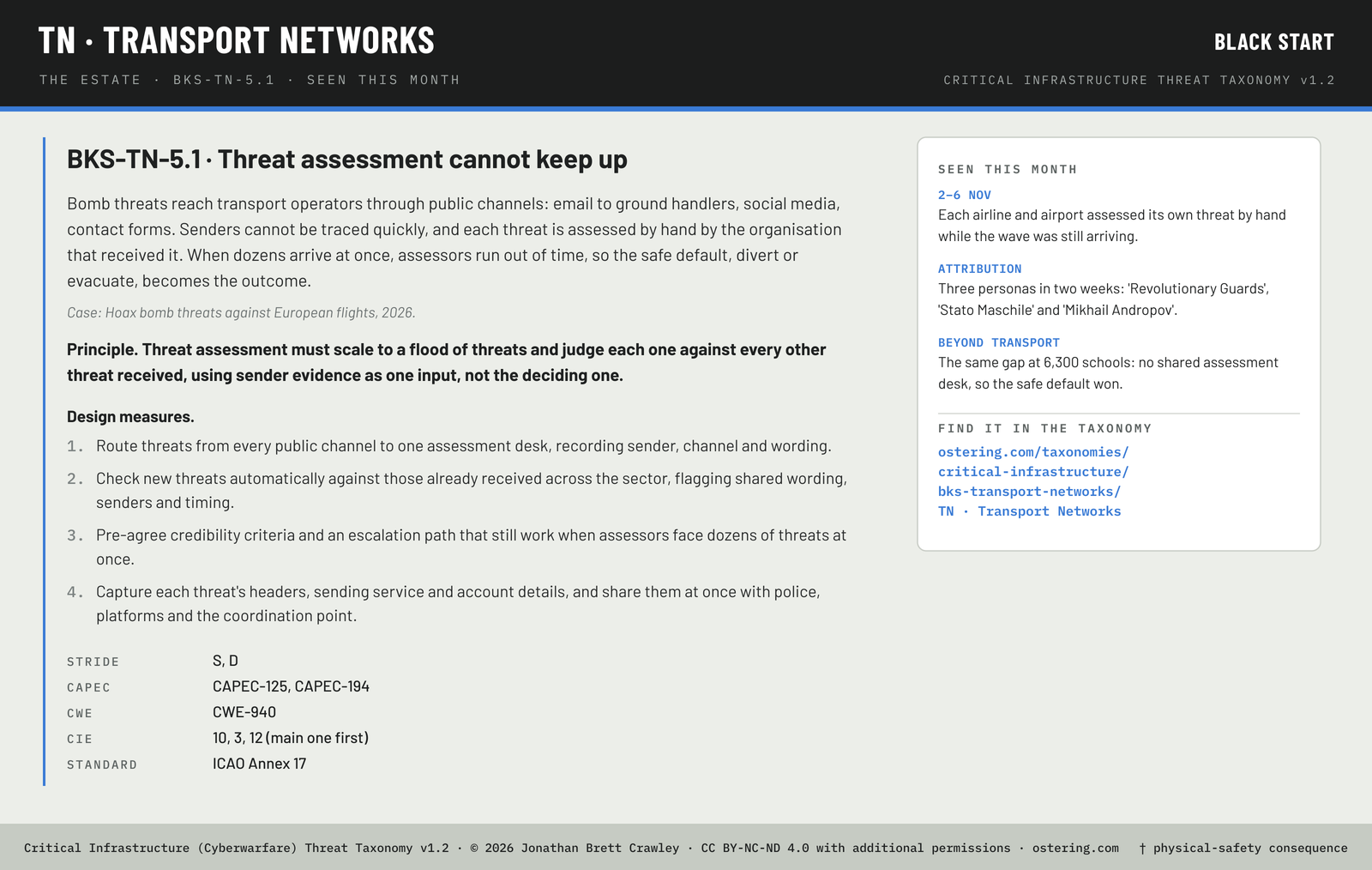
BKS-TN-5.1 Threat assessment cannot keep up is the Estate-side view of the same problem. When dozens of threats arrive at once and each is assessed by hand by whoever received it, the safe default (divert or evacuate) becomes the outcome. The card’s measures read like a design for the desk Italy didn’t have on 11 November: one assessment desk for every public channel, automatic matching against threats already received across the sector, pre-agreed credibility criteria, and each threat’s headers, sending service and account details captured and shared at once with police, platforms and the coordination point. Version 1.2 sharpened its principle too: judge each threat against every other threat received, using sender evidence as one input, not the deciding one.
The newest suit adds two more. Black Start v1.2 has an Emergency and Broadcast suit, covering emergency calls, dispatch, public warning and the broadcasters that carry emergency information. BKS-ES-3 Hoax calls send crews astray describes false emergencies arriving many at once across a region, tying up units and showing the adversary how the services respond. BKS-ES-8 Broadcasters go dark in a crisis is written about destructive attacks on playout and transmitters; on 6 November RTE aired music and pre-recorded messages for about three hours after an emailed threat. Neither card was written for emailed bomb threats, so I count both as partial fits, but both describe what the threats caused.
The shifting personas matter too. BKS-AD-8 A hacktivist persona hides a state and BKS-AD-4 Planted evidence points elsewhere describe a design in which uncertainty is a feature, because it slows the response. A copycat explanation fits some of the hoaxes just as well, and I’d be cautious about assuming a single hand behind all of them.
Accidents Publish the Same Data
The Microsoft 365 outage and the FAA’s nationwide ground stop on 13 November were not part of this. Microsoft reports no evidence of malicious activity, and preliminary reports say the FAA problem was not a cyberattack (KESQ/CNN).
But “not an attack” doesn’t mean “not useful to an attacker”. Live status pages and press round-ups listed which hospitals, courts, banks and ministries failed and which held. That’s BKS-RM-7 Live telemetry shows the effect and BKS-RM-10 Open data maps the cascade. Someone else’s outage can be the rehearsal.
How Far Is This From Real Disruption?
There’s no validated number, and the percentage of service lost turns out to be the wrong measure.
- Panic buying starts at almost no real loss. In September 2021, about 1% of UK petrol stations were closed when panic buying set in (Brayleys), and up to 90% of pumps in major English cities ran dry (Al Jazeera). That’s BKS-AD-9 Panic buying multiplies a small outage.
- A short blackout doesn’t cause unrest. The April 2025 Iberian blackout took out almost all of mainland Spain and Portugal, yet calm largely prevailed (Anadolu).
- A long, multi-service outage in a fragile place does. In Maracaibo in 2019, with power, water and communications gone, the city stayed calm for about 50 hours. Looting began once food and water ran out (Caracas Chronicles).
Duration past household reserves (the EU’s 72-hour self-sufficiency target exists for a reason), several essential services failing together, and an information vacuum matter far more than any percentage. Measured against that, the current campaign is a long way below the line.
How to Use the Taxonomy on Your Own Estate
You don’t need to have been hit to use any of this. In fact, it’s most useful if you haven’t:
- Take each incident in this post and ask “could it happen here?” Start with BKS-PE-10: list every maintenance function your controllers can start remotely, and what bounds it.
- Walk the Estate deck for your own sites. Which suits describe what you run? Fleet management and remote vendor access are where this month’s attacks came in.
- Lift the design measures into your plan, with the reference. “BKS-AD-K measure 2” in a ticket traces back to a threat, a principle and a real case.
- Run it as an exercise. The decks are built to be played: deal a Campaign card against an Estate card and ask what happens at 03:00 on a Sunday.
The taxonomies are free to use under CC BY-NC-ND 4.0, with additional permissions, and each one can be downloaded from its page in formats your tools can import, including SKOS.
Note to…
Note to operators: apply BKS-AD-K measure 2. If a remote management path was used against you, assume it’s open at your peers and your vendor’s other customers (BKS-SC-A The maintenance provider as master key), and share the technique, not just “we’re restored”.
Note to anyone running cold storage for food, medicines or blood: BKS-PE-10 measure 1 and CRI-FB-J.1 measure 3 together: bound defrost and service modes in the controller, and give every unit a temperature alarm that doesn’t depend on the controller, the network or the vendor.
Note to governments and CERTs: BKS-TN-5.1 is a design for a national threat-assessment desk. Don’t leave 6,300 headteachers to make 6,300 separate decisions.
Note to everyone writing incident reports: be thoughtful about how much response timing and control-failure detail you publish (BKS-AD-3 Disclosure teaches the adversary). Transparency matters, but so does not handing over the scorecard.
Final Thoughts
I want to be careful here, because this kind of analysis can tip into alarmism. Nothing so far has come close to the scale that causes real social disruption. Attribution is still open, and some of the hoaxes may well be copycats. The accidental outages are exactly that.
But the pattern is consistent with an adversary that has time (BKS-TR-3 The adversary has time) and is using it to learn. What a taxonomy gives you is a way to see the pattern across incidents that the news reports one at a time, and a set of design measures to act on before the next wave. The worst response is to treat each event as an isolated ticket. The best is to measure our own response before someone else does it for us.
Stay tuned!
Tags: Threat Taxonomy, Critical Infrastructure, Cyberwarfare, OT Security, Threat Modeling
You may also like:

Mapping the Critical Infrastructure Threat Taxonomy
Mapping the Critical Infrastructure Threat Taxonomy: STRIDE, CAPEC,...

A Threat Taxonomy for Care Monitoring at Home
Nobody Asked the Person Being Watched: A Threat...

Mapping the Care Assistant Threat Taxonomy
Mapping the Care Assistant Threat Taxonomy to STRIDE,...

A Threat Taxonomy for Hospitals and Medical Devices
The Hospital Never Closes: A Threat Taxonomy for...